Why this primer exists
This primer examines what supernatural rebellion looks like when it operates through human civilization, political authority, false worship, persecution, and compromise. It builds on the Unseen Realm primer and provides a historical and biblical pattern that later reaches its climax in Revelation’s Beast system.
Scripture presents a recurring convergence of supernatural rebellion, human political power, and false worship. Pergamum gives us a first-century historical window into that pattern. The final Beast system is its climactic expression, not its first appearance.
What Jesus actually said
Before examining the city’s history, begin with the controlling biblical text. In His message to the church at Pergamum, the risen Christ says:
“I know where you dwell, where Satan’s throne is. Yet you hold fast my name, and you did not deny my faith.”
Revelation 2:13 (ESV)
In the complete message, Revelation 2:12–17, Jesus:
- identifies Himself as the One with the sharp two-edged sword;
- commends believers who held fast His name even when Antipas was killed;
- rebukes the church for tolerating the teachings of Balaam and the Nicolaitans;
- commands the compromisers to repent; and
- promises hidden manna, a white stone, and a new name to the one who conquers.
Read the complete message in Revelation 2:12–17 (ESV) →
Scripture quotation marked ESV is from the English Standard Version, © 2001 Crossway. Used by permission.
How this primer fits the larger picture
These primers are complementary lenses, not a simplistic step-by-step chronology.
Unseen Realm
Explains the supernatural powers behind the conflict.
Pergamum
Shows the historical and biblical pattern of empire, worship, coercion, compromise, and witness.
Global Religious System
Explains religious seduction and pressure to compromise, followed by the transition to Beast-centered worship.
Beast System
Examines the technological and administrative infrastructure capable of enforcing Revelation 13 at scale.
The Eschatology primer supplies the overall prophetic map.
With that larger framework in view, the biblical pattern begins long before Pergamum—in Daniel’s accounts of empire, worship, persecution, and unseen powers.
1. Daniel establishes the pattern
Daniel 3 — Worship or die
Nebuchadnezzar erects an image and commands peoples, nations, and languages to worship. Refusal brings death. Shadrach, Meshach, and Abednego remain faithful even if God does not deliver them from the furnace.
Daniel 7 — Human empires become beasts
Daniel’s beasts are explicitly kings and kingdoms. Human empire viewed from heaven can become beastly. Revelation 13 deliberately reuses Daniel’s lion, bear, leopard, horns, and beast imagery. The final Beast culminates the pattern of rebellious human kingdoms.
Daniel 10 — The power behind the kingdom
Daniel 10 distinguishes three figures: the hostile supernatural prince associated with Persia; Michael, the archangel who stands for Israel; and the supernatural prince associated with Greece. Together, they reveal an unseen supernatural dimension behind earthly kingdoms. That gives us biblical background for understanding how visible empire and invisible rebellion can intersect. It does not authorize us to assign named spiritual rulers to modern nations, cities, or territories without biblical evidence.
Daniel establishes the biblical pattern. Pergamum shows what that pattern looked like in an actual first-century city addressed directly by Jesus.
2. Pergamum—the fortress city
Pergamum was already an ancient and influential city long before Christianity arrived. It became the capital of the Attalid kingdom—a Greek kingdom ruled by the Attalid dynasty—in the third century BC and later developed into a major political, cultural, and religious center under Rome. Its temples, altar, citadel, healing sanctuary, and imperial worship were not constructed in response to Christianity. They were already part of the world into which the gospel came.
The city’s fortified upper city—its acropolis or citadel—rose dramatically above the surrounding plain. The association of Pergamon with a fortress or citadel makes Jesus’ words especially striking and strengthens the connection between the city and throne-or-stronghold imagery. But the city’s name alone does not prove that Jesus was deliberately using wordplay, and it does not identify a particular monument as Satan’s throne.
Decades after Christ’s death and resurrection, the risen Jesus gave John a message for the actual Christian congregation living in Pergamum. When Jesus called their city the place “where Satan’s throne is,” He was interpreting its established religious and political environment from heaven’s perspective. The city’s long-standing power, pagan worship, and emperor-centered religious loyalty had become the setting in which Christians were required to hold fast Christ’s name without denying the faith or compromising it.
A city filled with worship
Pergamum contained major pagan cults and sanctuaries associated with Zeus, Athena, Asclepius, and others. It was also an important center of imperial worship—public religious honor offered to Rome and the emperor. Religion, political authority, civic identity, and public loyalty to Rome could therefore overlap.
Rome did not force every citizen to worship Caesar every day. But public ceremonies and civic festivals could include religious acts that treated the emperor or pagan gods as divine. A Christian could honor civil authority, but could not worship Caesar or give Rome the ultimate loyalty that belongs to Christ alone.
With so many centers of worship competing for allegiance, one question naturally arises: Did Jesus’ phrase identify a particular sanctuary or monument?
Was the Great Altar Satan’s throne?
Pergamum’s Great Altar is historically important and visually suggestive. Its sculpted Gigantomachy portrays the Greek gods battling the Giants. Even so, we cannot prove that Jesus meant the Great Altar specifically when He said “Satan’s throne.”
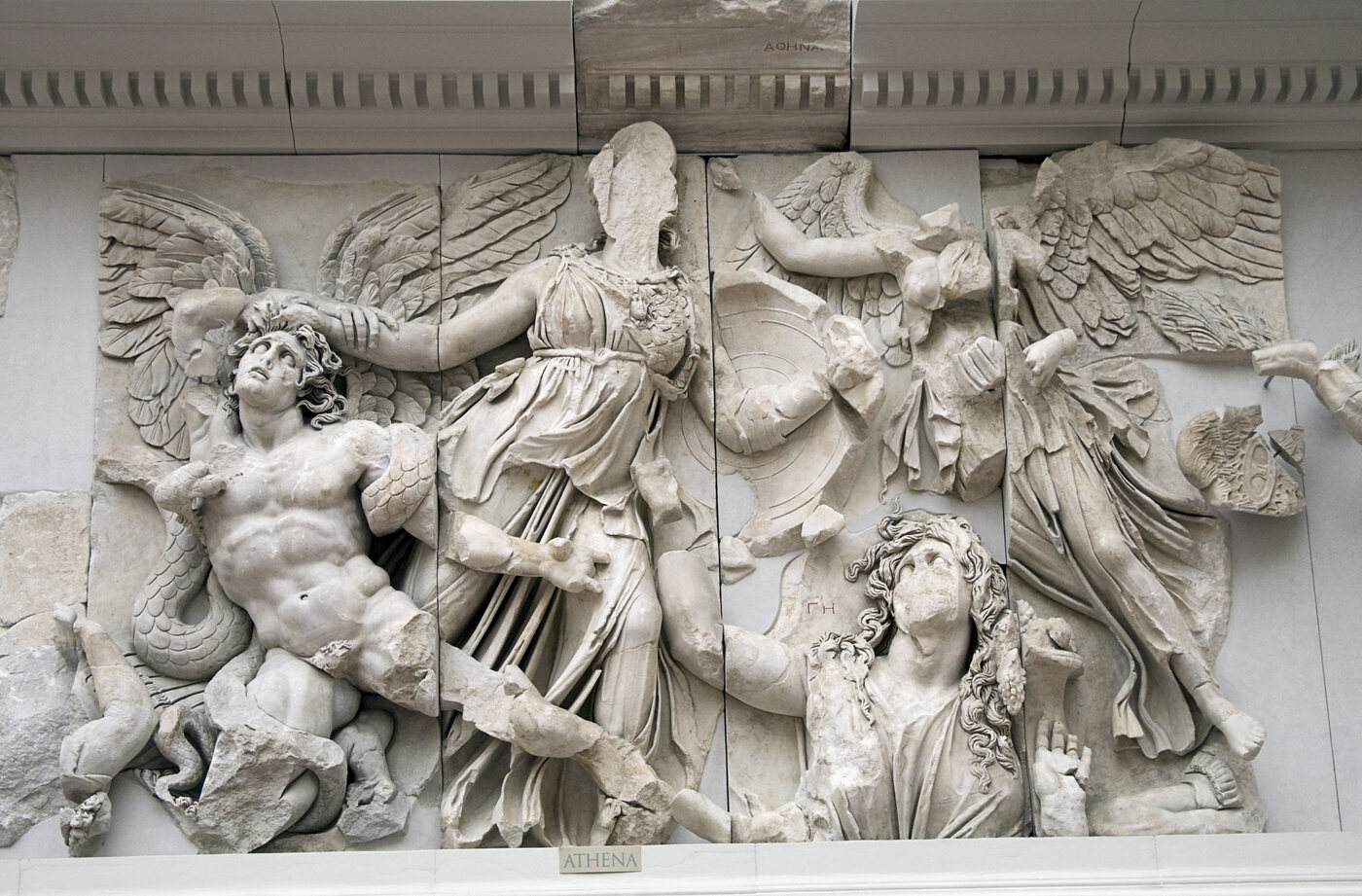
The stronger conclusion is that Pergamum embodied a religious and political order through which Satanic opposition to Christ’s people operated.
Whether Jesus intended one particular monument or the city’s larger religious and political order, His message directs attention to a greater authority.
Who really holds the sword?
Jesus introduces Himself to Pergamum as the One with the sharp two-edged sword. Rome may exercise earthly legal power—including the power to punish and kill—but Christ possesses ultimate authority and judgment. Empire can kill witnesses; it does not have the final word.
That contrast was not theoretical. Pergamum had already seen what happened when earthly power turned its sword against a faithful Christian.
3. Antipas—faithful witness where Satan dwells
Scripture gives little biographical detail about Antipas, so later traditions about his exact death should not be treated as established fact. Jesus calls him “My faithful witness” and links his death to the place where Satan dwells. The most natural conclusion is that allegiance—ultimate loyalty and worship—to Christ brought him into lethal conflict with the surrounding order.
How Pergamum shows us to fight higher powers
Jesus does not tell the church to bind, cast out, or overthrow Satan’s throne. He commends them because they hold fast His name and did not deny His faith.
This fits Ephesians 6: believers stand in truth, righteousness, faith, gospel witness, the Word of God, and prayer. Standing is active faithfulness. Christ ultimately deals with the throne.
But persecution from outside was not the church’s only danger. Believers who held fast Christ’s name under external pressure could still be enticed into compromise from within. To explain that second attack, Jesus points back many centuries—not to another event in Pergamum, but to Balaam’s role in Israel’s history during Israel’s journey toward the Promised Land.
4. Balaam—if you cannot curse them, corrupt them
Balak, king of Moab, feared Israel and hired Balaam to curse them. But Balaam could not curse those whom God had blessed. Later, while Israel was camped near Peor in Moab, Israelite men were enticed into sexual immorality, pagan sacrificial meals, and worship of Baal of Peor—the local form of Baal worshiped there. This event is commonly called the Peor episode. Numbers 31:16 supplies the interpretive key: the women involved acted on Balaam’s advice, causing Israel to act treacherously against the LORD.
Jesus Himself interprets the pattern in Revelation 2:14: Balaam taught Balak to put a stumbling block before Israel involving food sacrificed to idols and sexual immorality.
The enemy cannot overturn God’s blessing externally, so he seeks to entice God’s people into rebellion internally.
Antipas and Balaam therefore place two methods of attack side by side: outward pressure and inward enticement.
5. Two ways to attack God’s people
Antipas: coercion from outside
Pressure. Threaten. Persecute. Kill. Make faithfulness costly.
Balaam: corruption from inside
Entice. Normalize idolatry and sexual immorality. Blur boundaries. Make compromise appear harmless, reasonable, necessary, profitable, or pleasurable.
The methods differ, but the goal is the same: break exclusive allegiance to Christ.
Balaam’s method must not be reduced to a general warning about social pressure. Jesus identifies the specific sins that accompanied the compromise.
Sexual immorality is part of the strategy
Jesus explicitly names sexual immorality. The Peor episode intertwines sexual sin and idolatry. We must not reduce this to a vague warning about “fitting in with the culture.” Physical compromise can become part of unfaithfulness to God.
In the Greco-Roman world, religion, social life, commerce, festivals, meals, sexuality, and civic identity could overlap. That created pressure to participate, rationalize, accommodate, and cross boundaries.
That danger was not confined to ancient Israel. Jesus says that teaching which tolerated compromise was also present inside the church at Pergamum.
The Nicolaitans and the crisis of allegiance
The precise historical relationship between the Balaamites and Nicolaitans is debated, and this primer does not pretend to solve it. Jesus places the warnings together because compromise is incompatible with exclusive allegiance to Him. A church may withstand persecution and still be corrupted by trying to fit in with the surrounding culture.
When persecution fails, seduction remains
Satan does not necessarily need Christians to verbally renounce Christ if he can persuade them to compromise their allegiance to Christ.
Coercion attacks faithfulness through fear.
Seduction attacks faithfulness through desire.
Both seek allegiance.
What appeared together in one first-century church—coercion through fear and corruption through desire—reappears on a worldwide scale in Revelation’s final system of worship and control.
6. From Satan’s throne to the Dragon’s throne
Revelation 2 locates “Satan’s throne” at Pergamum. Revelation 12 identifies the ancient serpent as the Devil and Satan. Revelation 13 says the Dragon gives the Beast his power, throne, and great authority.
The connection is strong, but this does not mean the throne geographically “moves” from Pergamum or that every use of “throne” is identical in every respect. Satan’s false claim to rule is expressed through earthly political power and reaches a global climax in the Beast.
This final development does not abandon the earlier biblical imagery; it gathers that imagery together and brings it to its climax.
Daniel’s beasts and image-worship return
Revelation 13 reuses Daniel 7’s beast imagery and Daniel 3’s pattern of enforced worship. Empire, image, commanded worship, and threatened death return on a global scale. Shadrach, Meshach, Abednego, Antipas, and Revelation’s faithful saints face the same underlying question: Whom will you worship?
The final system also intensifies both methods already seen at Pergamum.
Coercion and seduction in the final system
Revelation 13 emphasizes coercion: worship demand, persecution and death, and economic restriction—“Bow or suffer.” Revelation 17–18 portrays the global religious system’s seduction through wealth, luxury, commerce, immorality, false worship, and political influence—“Join us and prosper.”
Balaam and Babylon are not declared prophetically identical. They belong to a repeated biblical pattern: fear and desire remain complementary weapons used to break allegiance to God.
We can now trace this recurring conflict across the biblical passages that have shaped the argument.
7. The pattern across Scripture
- Daniel 3: empire, image, worship, refusal.
- Daniel 7: beast kingdoms.
- Daniel 10: supernatural powers behind kingdoms.
- Pergamum: political authority, emperor-centered rule and worship, false worship, Satan’s throne, persecution, and compromise.
- Antipas: faithful witness under coercion.
- Balaam: sexual immorality, idolatry, and internal corruption.
- Revelation 12: the Dragon identified as Satan.
- Revelation 13: Satan gives the Beast power, throne, and authority; worship and coercion become global.
- Revelation 17–18: Babylon seduces through wealth, luxury, immorality, commerce, and false worship.
What Pergamum teaches us about the future
The central issue is allegiance—not merely technology, international politics, or persecution. Who possesses ultimate authority? Whose name will people hold? Whom will they worship? What compromises will people accept for comfort, social belonging, economic participation, sexual or cultural acceptance, or safety?
The pattern is compelling, but responsible interpretation requires us to distinguish what Scripture states explicitly from conclusions drawn through historical context and biblical synthesis.
8. Evidence guardrails
We should state each conclusion with the level of certainty the evidence permits.
Scripture explicitly establishes
- Daniel’s beasts represent kingdoms and rulers.
- Daniel describes supernatural princes associated with Persia and Greece.
- Jesus says Pergamum is where Satan’s throne is.
- Antipas was killed while remaining faithful.
- Jesus says Balaam taught Balak to place a stumbling block before Israel involving idolatry and sexual immorality; Numbers confirms Balaam’s counsel.
- The Dragon is Satan.
- The Dragon gives the Beast power, throne, and authority.
- The Beast demands worship, persecutes, kills, marks, and controls economic participation.
- Christ destroys the Beast.
Historical context
Pergamum was a major political and religious center of Roman Asia. Imperial worship was important, and civic, political, and pagan religious life overlapped.
Strong biblical synthesis
Pergamum gives us a first-century historical picture of the pattern that reaches its global climax in the Beast system. Antipas models faithful witness. Balaam shows how corruption can be used when direct opposition fails. Daniel’s beasts and princes, Pergamum’s throne, and Revelation’s Beast throne form a coherent pattern that becomes clearer as Scripture unfolds.
What we do not claim:
- The Great Altar was definitely Satan’s throne.
- Satan’s throne geographically moved.
- The exact charge against Antipas or the method of his execution is known.
- Balaam and Babylon are prophetically identical.
- Every modern institution is directly controlled by a named supernatural prince.
- Every surveillance, identity, financial, artificial-intelligence, or other technology is the Mark.
We watch carefully, but we do not manufacture certainty where God has not given it.
Once those boundaries are clear, the central command of the passage remains unmistakable: Christ calls His people to remain faithful.
9. Why This Matters: Faithful Witness
Antipas lived where Satan’s throne was, held fast Christ’s name, and died faithful. Revelation 12:11 describes saints overcoming by the blood of the Lamb, the word of their testimony, and refusing to love their lives even unto death.
Faithful witness does not necessarily mean physical survival. The Beast may kill the body, but it cannot obtain the worship of those who remain loyal to Christ.
Christ, not Satan, has the final throne
Satan’s throne, the Beast’s throne, and every human throne are temporary. Jesus is King of kings and Lord of lords. The Beast and False Prophet are defeated, Satan is judged, and Revelation ends with the throne of God and the Lamb. The counterfeit disappears. The true kingdom remains.
Pergamum is a historical window into a larger biblical pattern. Antipas represents coercion: “Deny Christ or suffer.” Balaam represents corruption: “You don’t have to deny Christ. Just compromise.” Revelation expands both dynamics globally.
The Christian response remains: Hold fast His name. Do not deny the faith. Do not compromise. Stand.
The way of escape is still open
If you have not yet trusted Jesus Christ as Lord and Savior, the door is still open.
Escape the Coming Wrath →