Why this primer exists
Eschatology simply means the Bible’s teaching about the last things and the completion of God’s plan. It is not a pile of disconnected predictions.
Scripture gives history a clear destination: Christ will gather His Church, God will complete His promises to Israel, Jesus will return and reign, judgment will come, and God will dwell with His people forever.
God revealed these things not to fuel speculation, but to give believers hope, urgency, discernment, and confidence in His Word. Tribulation, wrath, and judgment are real and approaching—but the same God who will judge the world offers rescue now through Jesus Christ.
2. How We Read Prophecy
We read prophecy the same basic way we read the rest of Scripture. We pay attention to the normal meaning of the words, the grammar, the historical setting, and the surrounding context.
When a passage clearly uses a symbol, we treat it as a symbol. But we do not turn a clear statement into a symbol or spiritual idea simply because it describes a future event.
This approach keeps the promises God made to Israel distinct from the promises He made to the Church. It also allows the prophetic timeline to unfold in the order the Bible actually presents it. For a fuller explanation of this method, see How We Read the Bible.
Start with the Old Testament Foundation
The book of Revelation is the culmination of biblical prophecy, not its starting point. John writes with language, images, promises, and expectations that God had already established throughout the Old Testament.
So we normally read the prophetic story forward through Scripture: Old Testament foundation → Jesus and the apostles → Revelation → whole-Bible synthesis (putting all the relevant passages together). Revelation gives further light and brings earlier prophecy toward its climax, but it assumes that foundation rather than replacing it.
- Daniel 7, 9, and 12 provide essential background for the Beast, the final seven-year period, the midpoint crisis, and the repeated three-and-a-half-year time frame.
- Exodus provides the background for many of Revelation’s plague-like judgments.
- Isaiah, Joel, and the other prophets establish the Day of the LORD—God’s decisive intervention in judgment—along with cosmic signs and the gathering of the nations.
- Ezekiel 38–39 provides the earlier biblical setting for the names Gog and Magog.
- Zechariah 12–14 gives major background for Jerusalem, the nations, Israel’s future turning, and the coming King.
- Isaiah 13–14 and Jeremiah 50–51 help establish the biblical background for Babylon before Revelation 17–18 develops the theme further.
- Genesis, Isaiah 65–66, and Ezekiel 47 help us recognize the new-creation, river, tree-of-life, and curse-removed imagery that reaches its climax in Revelation 21–22.
This does not mean every image in Revelation has a simple one-to-one Old Testament key. John can combine several earlier images, develop them, and show their final fulfillment. The rule is simpler: before deciding what John means, first ask what God had already revealed.
Later revelation can clarify and expand earlier prophecy, but it does not automatically erase the plain meaning of earlier promises. We therefore should not use Revelation’s symbolic imagery to cancel clear Old Testament promises. This is especially important for promises concerning Israel, Jerusalem, the nations, and the coming kingdom. A later text should change who or what those promises refer to only when Scripture itself clearly requires it.
The book of Revelation is the last major prophetic book, not the first. Read the Old Testament foundation first, then follow how Jesus, the apostles, and John develop the same prophetic story.
Certain time indicators in the prophets — including Ezekiel’s 430 days — were sealed until the time of the end and only became clearer after Israel returned to the land. See section 7 for that detail.
3. The Big Picture Timeline
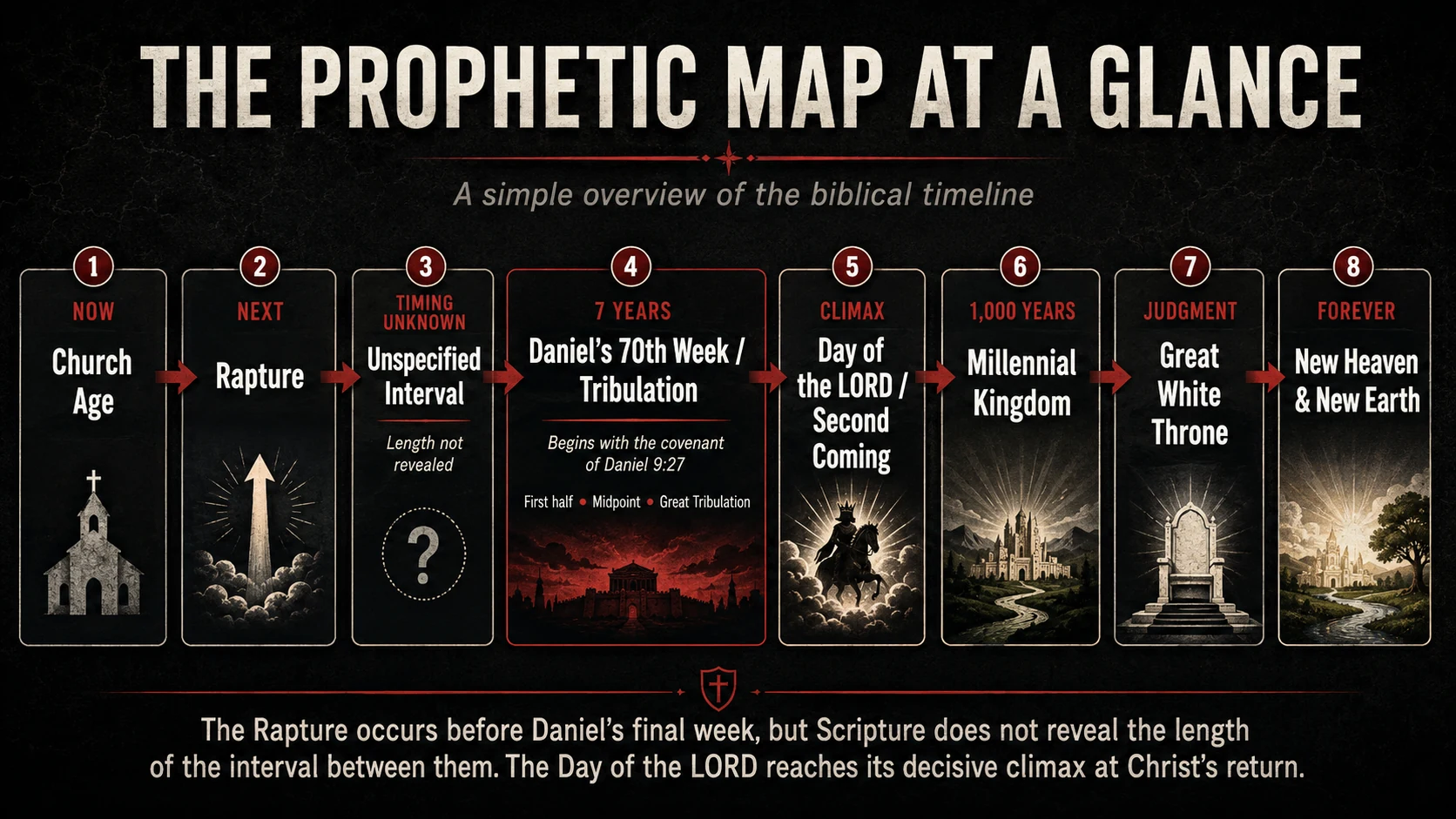
When read in order, the major stages of the prophetic program are clear:
- The present Church Age—the period in which Christ is building His Church
- The Rapture of the Church—the sudden catching up of believers to meet Christ in the air
- The seven-year Tribulation—a future period of divine judgment that fulfills Daniel’s 70th week, the final seven years of Daniel’s prophecy concerning Israel and Jerusalem
- The Second Coming of Christ—Jesus’ visible return to the earth in power and glory
- The Millennial Kingdom—Christ’s literal 1,000-year reign on earth
- The final rebellion and Great White Throne Judgment—the final judgment of the unsaved dead
- The New Heaven and New Earth — eternity
This sequence is not arbitrary. Its framework begins in the Old Testament, especially in Daniel, is clarified by Jesus and the apostles, and is brought to its climax in Revelation.
That framework only stays clear when Israel and the Church are kept distinct.
God has revealed where history is going. The Church awaits Christ, Israel’s prophetic program will be completed, Christ will return and reign, judgment will come, and God’s people will dwell with Him forever.
4. Israel and the Church Remain Distinct
One of the most important keys to end-times prophecy is keeping national Israel and the Church distinct. God made promises to each, and He will fulfill those promises as He gave them.
- National Israel has unconditional promises—commitments God Himself guaranteed and will fulfill regarding the land, the nation, and the throne of David.
- The Church is the Body and Bride of Christ—biblical pictures describing the Church’s union with and relationship to Jesus, with heavenly promises and a unique relationship to Jesus.
These two groups are not merged or replaced in God’s prophetic program. This does not mean two ways of salvation: Jews and Gentiles alike are saved only by grace through faith, on the basis of Christ’s finished work. Keeping Israel and the Church distinct preserves the promises God made to each without compromising the one gospel.
5. The Rapture and the Tribulation
The Rapture and the Tribulation are related, but they are not the same event. The Rapture is Christ gathering His Church to Himself. The Tribulation is the final seven-year period of Daniel’s prophecy concerning Israel and Jerusalem. Keeping those two events distinct helps the rest of the prophetic timeline fall into place.
The Rapture — Christ Gathers His Church
Christ will come in the air for His Church (1 Thessalonians 4:16–17). The dead in Christ will rise first, and living believers will be caught up together with them to meet the Lord in the air.
This is what theologians mean by imminence: Christ could gather His Church at any moment. Scripture gives no prophetic event that must occur first.
The Word “Rapture”
The English word “rapture” does not appear in most English Bible translations, just as the word “Trinity” does not. The concept itself is plainly present in the text.
The term comes through the Latin Vulgate, an influential Latin translation of the Bible. In 1 Thessalonians 4:17, the Vulgate uses a form of the Latin verb rapio for believers being “caught up.”
The Greek verb in the New Testament is harpazō (ἁρπάζω), meaning to seize, snatch, or take suddenly. The same verb appears when Philip is “caught away” in Acts 8:39 and when Paul is “caught up” in 2 Corinthians 12:2–4.
Old Testament Examples
The Old Testament already gives examples of God taking living people from the earth without ordinary death.
- Enoch — “Enoch walked with God; and he was not, for God took him” (Genesis 5:24).
- Elijah — Elijah went up by a whirlwind into heaven (2 Kings 2:1, 11).
Neither event is the Rapture of the Church. They simply demonstrate that supernatural removal by God is already a biblical concept.
Why We Place the Rapture Before the Tribulation
The Church is repeatedly told to expect Christ and is promised deliverance from the coming wrath (1 Thessalonians 1:10; 5:9). Revelation 3:10 also promises the faithful church deliverance from the coming worldwide hour of trial.
— Revelation 3:10
After the letters to the churches end in Revelation 3, the book shifts to heaven, judgment, Israel, and the nations. The Church is not named again until Revelation’s closing chapter. That structure is consistent with, though not by itself proof of, the Church having been removed before the Tribulation.
For these reasons, DETN understands the Rapture to occur before Daniel’s final seven-year period begins.
What Is the Tribulation?
The term Tribulation is commonly used for Daniel’s 70th week, the final seven years of Daniel’s prophecy concerning Israel and Jerusalem (Daniel 9:24–27). It is a period of divine judgment, intense conflict, deception, persecution, and God’s renewed dealings with Israel.
The Old Testament establishes this framework before the book of Revelation fills in later details. Daniel describes the final seven, its midpoint crisis, and an unparalleled time of distress. Jeremiah calls Israel’s future distress “the time of Jacob’s trouble” (Jeremiah 30:7). Joel, Zephaniah, and Zechariah describe the coming intervention of the LORD, judgment of the nations, Jerusalem’s crisis, and the kingdom that follows.
An important distinction: the Rapture does not itself start Daniel’s 70th week. Daniel 9:27 ties the seven-year period to a covenant confirmed or made strong “with the many” for one seven. The Rapture occurs before that period in the pre-Tribulation framework, but Scripture does not tell us how long the interval between the Rapture and the covenant will be.
The Day of the LORD — Context Determines the Scope
“The Day of the LORD” is a broad biblical expression whose precise meaning and duration come from its context. The word day can describe a literal day, a decisive event, or a longer era marked by God’s intervention. We should not assume that every occurrence has exactly the same starting point, ending point, or duration.
The expression has a consistent theological core: the LORD decisively intervenes in human history, especially in judgment, deliverance, and the vindication of His purposes. Some Old Testament passages use Day-of-the-LORD language for historical judgments. Those real events also help establish the pattern of a greater future intervention.
In its ultimate eschatological use, the Day of the LORD reaches its decisive climax at the end of the Tribulation. Christ visibly returns, judges His enemies, delivers Israel, ends the Beast’s rule, and establishes His kingdom on the earth.
Zechariah 14 is a key Old Testament anchor. The nations gather against Jerusalem; the LORD goes forth to fight; His feet stand on the Mount of Olives; and then “the LORD shall be King over all the earth” (Zechariah 14:3–9). The chapter continues with surviving nations coming to worship the King (Zechariah 14:16). The movement is judgment → deliverance → the reign of the LORD.
Joel gives the same basic direction. The nations are gathered for judgment, cosmic signs appear, the LORD intervenes for His people, and Jerusalem is made holy (Joel 3). Jesus later says that immediately after the Tribulation the heavenly signs occur and the Son of Man appears (Matthew 24:29–31). Revelation 19–20 then gives the fuller picture: Christ returns, defeats the Beast and his armies, Satan is bound, and Christ’s thousand-year reign begins.
This is why DETN does not simply use “the Day of the LORD” as another name for the entire seven-year Tribulation. The Tribulation moves history toward the great climactic intervention of the LORD at Christ’s return.
At the same time, context can give the expression a broader horizon. In 2 Peter 3:10–13, Peter speaks of the Day of the Lord and looks all the way toward the dissolution of the present creation and the new heavens and new earth. Peter may be using the Day as a broad eschatological era, or he may be telescoping from the Day’s arrival to its final consummation. Either way, that passage warns us not to force every use of the phrase into one identical time span.
Context determines the scope of “the Day of the LORD.” It can describe a literal day, a decisive intervention, or a broader era. Its great end-times climax comes at the end of the Tribulation when Jesus Christ returns in judgment, delivers Israel, defeats His enemies, and establishes His Millennial Kingdom.
The Seven-Year Period Has a Biblical Structure
- First half — about 3½ years: Daniel’s covenant is in force, sacrificial worship is functioning, and the Beast/Harlot order—the temporary alliance between the Beast’s political power and Revelation 17’s corrupt worldwide religious system—develops.
- Midpoint: sacrifice is stopped, the abomination of desolation—the future desecration of the holy place foretold by Daniel and Jesus—occurs, and the man of lawlessness openly exalts himself (Daniel 9:27; Matthew 24:15; 2 Thessalonians 2:4).
- Second half — about 3½ years: persecution and direct Beast worship intensify. Jesus describes the period following the abomination as “great tribulation” (Matthew 24:21).
- Climax: Christ returns openly in power and glory, judges His enemies, delivers Israel, and the world enters the reign of the King.
So DETN commonly uses Tribulation for the whole seven-year period, while recognizing that Jesus’ phrase “great tribulation” especially describes the intensified second half after the abomination of desolation.
What Is God Accomplishing During the Tribulation?
The Tribulation is not merely seven years of unexplained catastrophe. God is judging a rebellious world and exposing the failure of counterfeit religious and political systems. He is also bringing Israel through severe refinement, saving people who turn to Him during that period, and moving history toward the visible return and reign of Jesus Christ.
The period therefore has a destination. It culminates not in chaos, but in the appearing of the rightful King.
The Covenant, the Third Temple, and the Midpoint Betrayal
Daniel 9:27 says a coming ruler confirms or makes strong a covenant “with the many” for one seven. The verse does not call it a “peace treaty.” Because the passage concerns Daniel’s people, Jerusalem, the sanctuary, and sacrifice, the covenant belongs in an Israel-and-Jerusalem setting. It may provide peace or security, but we should not make the text say more than it says.
What Scripture says. The covenant lasts for one seven. Halfway through that period, the coming ruler stops sacrifice and offering (Daniel 9:27). Daniel 12:11 again connects the removal of regular sacrifice with the abomination of desolation, the future desecration Jesus says will occur in the holy place.
The case for a future Temple comes from several passages together. Jesus places Daniel’s abomination in the “holy place” (Matthew 24:15). Paul says the man of lawlessness will sit in the temple of God and exalt himself (2 Thessalonians 2:4). Revelation 11:1–2 describes a temple, an altar, worshipers, and the holy city being trampled for forty-two months.
Taken together, these passages strongly support a functioning future Jewish sanctuary or Third Temple in Jerusalem during Daniel’s final seven years.
What we can reasonably infer. The Daniel 9 covenant may be the political or security arrangement that allows the Temple to be built or Jewish sacrifice to resume.
What Scripture does not say. The Bible never tells us that the covenant contains a specific “Temple-construction clause.” It only requires that sacrificial worship be functioning by the midpoint.
False Security, the Harlot, and the Beast
Isaiah 28 gives us an important pattern of false security. In its historical setting, Jerusalem’s rulers trusted a covenant they believed would protect them from an “overwhelming scourge.” God exposed that confidence as false and said the covenant would fail (Isaiah 28:14–22).
We should not simply declare that Isaiah 28 and Daniel 9 describe the same covenant. But the pattern is worth comparing with Daniel’s final seven years and Revelation 11’s trampling of Jerusalem.
Revelation 17 adds a religious dimension. The Harlot is already riding the Beast. The corrupt religious system and the Beast’s political power therefore operate together for a time.
Later, the Beast and the ten kings turn against the Harlot and destroy her (Revelation 17:16–17). Revelation 13 shows worship being directed toward the Beast himself and enforced.
The Harlot’s reach appears worldwide and near-universal. Revelation 17:15 identifies her waters as “peoples, multitudes, nations, and tongues.” Revelation 17:2 connects her with kings and the inhabitants of the earth. Revelation 18:3 says all nations have drunk from Babylon’s influence.
That does not require every person to become a formal member of one organized religion. It does mean the religious deception reaches across the world. Faithful believers remain the crucial exception.
Israel may take part in the wider order without embracing the Harlot’s religion. Revelation never says Israel converts to or formally joins the Harlot system. If Daniel’s covenant provides enough security or religious freedom for Temple worship to function, Israel may participate in or benefit from the wider order while continuing Jewish worship.
The midpoint appears to expose the deception. Sacrifice is stopped. The holy place is desecrated. The man of lawlessness openly exalts himself in the Temple. Jesus tells those in Judea to flee when the abomination appears (Matthew 24:15–22).
Revelation 17 shows the Beast-centered order destroying the Harlot it once carried. Revelation 13 moves to direct, compulsory Beast worship. The broad progression fits the passages well. Details the Bible does not state directly must remain inference rather than doctrine.
A short word-study note. In 2 Thessalonians 2:3, Paul uses the Greek word apostasia, meaning rebellion, defection, or apostasy. The Greek word for a certificate of divorce is apostasion. The words are related, but they are not interchangeable.
Psalm 83 may describe a pattern, or possibly a future conflict, in which surrounding enemies seek Israel’s destruction as a nation. But Psalm 83 does not explicitly place such a war immediately before Daniel’s 70th week or say that it produces Daniel’s covenant.
Daniel 9 gives us a seven-year covenant, a functioning sacrificial system, and a betrayal at the midpoint. Revelation shows a worldwide Harlot system riding with the Beast, followed by direct and compulsory Beast worship.
Israel may participate in or benefit from the early security arrangement without embracing the Harlot’s religion. The midpoint desecration exposes the deception and forces the question of allegiance.
Scripture may describe an arrangement that produces peace and security, but Daniel 9:27 never actually calls it a “seven-year peace treaty.”
Jesus Himself described the character of those days in the Olivet Discourse.
6. Jesus’ Olivet Discourse
The Olivet Discourse—Jesus’ teaching on the Mount of Olives recorded in Matthew 24–25, Mark 13, and Luke 21—is His longest recorded teaching on the end of the age. He gave it to Jewish disciples after they asked Him about the Temple, His coming, and the end of the age.
Most of this discourse is about Israel’s future, not the Church.
The setting is the Temple and Jerusalem, and the questions begin with that Temple and the end of the age.
Jesus speaks of the abomination of desolation—the future desecration foretold by Daniel—along with flight from Judea, the Sabbath, and the great tribulation. Those details fit Daniel’s prophecy about Israel.
At the time Jesus spoke these words, the Church as the Body of Christ had not yet been formed.
When the discourse is read as if it is mainly instructions for the Church, confusion follows:
- The Church is forced into Israel’s Tribulation
- The “elect” (God’s chosen people in that context) gathered after the tribulation are misread as the Church at the Rapture
- Jewish details (Sabbath, Judea, the holy place) are treated as symbols that replace their ordinary historical meaning or ignored
- The clear connection to Daniel’s 70th week is weakened or lost
A.D. 70 is real — and it is a foreshadowing
The destruction of Jerusalem and the Temple in A.D. 70 was a real and terrible fulfillment of Jesus’ near-term warnings. It is prophetically important.
But it was not the final abomination of desolation described by Daniel and pointed to by Jesus later in the discourse.
A.D. 70 therefore serves as a foreshadowing: a real historical judgment that points forward to a greater future desolation in Daniel’s 70th week.
History also records that the Jewish believers who heeded Jesus’ warning fled the city (traditionally to Pella) and were largely spared, while those who remained faced the full horror of the siege. The warning was literal, local, and lifesaving for those who took His words at face value.
The parables that follow
The parables immediately after the main discourse (the faithful and evil servant, the ten virgins, the talents, and the sheep and goats) belong to the same conversation. They are not a sudden switch to generic Church-age teaching.
Some of the watchfulness material can be applied to any believer who should stay ready. But the sheep and goats judgment (Matthew 25:31–46) is best understood as the judgment of the nations when Christ returns to earth. The standard is how they treated “these My brethren” — a reference that fits Israel and the Jewish believers and messengers during that future time, not the Church as a whole.
Reading every one of these parables as if it is mainly about the Church’s present program again blurs the line between Israel and the Church and pulls the Church into the Tribulation framework Jesus was describing.
One more common confusion: when Jesus says one will be “taken” and the other “left” (Matthew 24:40-41), He is not describing the Rapture. He has just compared His coming to the days of Noah, when the flood took the wicked away. In that context, those taken are removed in judgment; those left enter the kingdom that follows. The Rapture is a different event, taught clearly in passages such as 1 Thessalonians 4:16-17.
Jesus is not only describing the suddenness of judgment. By pointing to the days of Noah, He is also pointing back to the moral and spiritual corruption of that age — the violence, the breakdown of boundaries, and the conditions that brought the flood (Genesis 6). The last days will resemble both the sudden judgment and the dark climate that preceded it.
7. Israel’s Future and the Time of Jacob’s Trouble
God is not finished with the Jewish people as a nation. In Romans 11 the Bible says that for a time most of them have not believed in Jesus as their Messiah. This is temporary. God still keeps every promise He made to them. One day the whole nation will turn to Him.
The Tribulation is also called “the time of Jacob’s trouble—a prophetic name for Israel’s future period of severe distress” (Jeremiah 30:7) — a period of intense suffering for Israel. During those years the Jewish people will face extreme pressure. Many will finally recognize Jesus as their true Messiah and turn to Him (Zechariah 12:10). The pressure concentrates on Jerusalem because God set that city “in the center of the nations” (Ezekiel 5:5); the prophets repeatedly show the nations drawn into conflict around her.
Israel’s Return and the 430 Days of Ezekiel
In Ezekiel 4:4–6 the prophet is told to lie on his side for 390 days for the house of Israel and 40 days for the house of Judah — a total of 430 days. God assigns the days “a day for each year” (Ezekiel 4:6, ESV).
Some prophecy interpreters apply a day-for-a-year principle and a 360-day prophetic year to Ezekiel’s 430 days. After subtracting the years associated with the Babylonian judgment and applying the remaining period, they understand the calculation as pointing toward 1948. This interpretation depends on several assumptions and is not stated explicitly in Ezekiel, but DETN considers the correspondence significant.
Can a Nation Be Born in a Day?
Isaiah asked a remarkable question:
— Isaiah 66:8
On May 14, 1948, Israel declared its independence. After centuries without a Jewish sovereign nation in the land, Israel suddenly stood again among the nations of the world.
Isaiah 66 looks beyond 1948 to Israel’s ultimate restoration, so we should not treat this verse as though its entire meaning was fulfilled on that day. But the resemblance is striking: a nation that had disappeared from the map was suddenly reborn in its ancient homeland.
That rebirth is the clearest national fulfillment of restoration prophecies in nearly two thousand years. It does not start the seven-year Tribulation, and it does not set a date for the Rapture. What it does mark is the beginning of the final stage of the prophetic program for Israel. From 1948 forward, Israel has been back in the land as a nation, but the nation as a whole has not yet recognized Jesus as its Messiah. In that sense, Israel is back in the land “in unbelief,” awaiting the future spiritual restoration Scripture describes (Jeremiah 30:7; Ezekiel 36–37; Zechariah 12–14).
This is why we treat 1948 as the single most significant prophetic marker of the last days so far. Israel’s restoration does not give us a date for the Rapture or establish a calculable countdown. It does, however, place the nation of Israel back in the position required for the remaining Israel-centered prophecies to be fulfilled.
Sealed Until the Time of the End
Daniel was told to seal the book until the time of the end (Daniel 12:4, 9). The full clarity of certain time prophecies was not meant to be forced early. Once Israel returned to the land in 1948 (and recovered Jerusalem in 1967), those long-sealed indicators became much clearer to those carefully searching the text. Some interpreters understand Daniel’s picture of “running to and fro” as diligent searching through the prophetic writings rather than a prediction of modern transportation. That reading fits the increasing effort to understand prophecies that Daniel was told would remain sealed until the time of the end.
8. Revelation Structure
By the time John writes Revelation, the basic prophetic vocabulary is already established. He draws heavily on Daniel, Exodus, Isaiah, Ezekiel, Zechariah, and other Old Testament books as he describes the final crisis and the return of Christ.
The book of Revelation describes the Tribulation in three main series of judgments: seals, trumpets, and bowls. Understanding how these series relate is essential for reading the book clearly.
The three series
- Seven seals (Revelation 6; 8:1) — the beginning of God’s judgments; the seventh seal opens into the trumpets.
- Seven trumpets (Revelation 8–9; 11:15–19) — intensifying judgments; the seventh trumpet opens into the final phase.
- Seven bowls (Revelation 16) — the final, complete outpouring of God’s wrath.
Sequence or recapitulation?
Two main approaches appear among those who take Revelation seriously:
- Strict sequence — the seals, trumpets, and bowls unfold one after another in chronological order, with increasing intensity.
- Recapitulation — the three series largely cover the same period from different angles, each cycle advancing the story and focusing on different aspects of the same judgments.
Both views can be held by people who affirm a future Tribulation and a literal return of Christ. What matters most is that the judgments are real, future, and from God — not merely symbols of past church history or present spiritual struggle.
How this site reads it
We treat the seals, trumpets, and bowls as progressive and intensifying judgments within Daniel’s 70th week.
Some readers see them as mostly sequential. Others see more overlap, with later visions returning to the same period from another angle. Either way, Revelation moves toward the same climax: Christ returns, defeats the Antichrist, and establishes the Millennial Kingdom.
Chapters 10–15 contain several parenthetical sections—passages that pause the main sequence to add detail. They explain more about Israel, the two witnesses, the Beast system, and the persecution of people who belong to God during that period.
9. The Second Coming and the Millennial Kingdom
At the end of the Tribulation, Jesus will return to the earth in power and glory (Revelation 19; Zechariah 14). This is the Second Coming, distinct from the Rapture. He will defeat the Antichrist and the armies gathered against Him, judge the surviving nations, and establish His kingdom.
The Mount of Olives Will Split
Zechariah gives an unusually specific detail about Christ’s return:
— Zechariah 14:4
The Mount of Olives will split, creating a great valley running east and west. Jerusalem is in an earthquake-prone region, and faults exist in the surrounding area. But claims that geologists have confirmed an active east-west fault running directly beneath the Mount of Olives are stronger than the evidence supports.
More importantly, Zechariah does not say an existing fault causes the mountain to split. It happens when the Lord stands on the Mount of Olives. The prophecy does not depend on a fault line already being there.
The temple described in Ezekiel 40–48 will operate during this kingdom. Within this framework, its sacrifices do not compete with or repeat Christ’s once-for-all sacrifice. They function ceremonially and memorially within the Millennial Kingdom, looking back to what Jesus finished on the cross.
At the end of the thousand years, Satan will be released for a final rebellion, which will be quickly destroyed. Then comes the Great White Throne Judgment, where the unsaved dead are judged and cast into the lake of fire.
10. The Eternal State
After the final judgment, God creates a new heaven and a new earth (Revelation 21–22). The New Jerusalem comes down from heaven. God dwells with His people. There is no more death, mourning, crying, or pain. The curse is removed. In this eternal state there is no temple, because the Lord God Almighty and the Lamb are its temple.
This is the final and unending fulfillment of God’s plan.
11. How We Should Live in Light of These Things
God’s prophetic program is moving steadily toward its conclusion. Tribulation, wrath, and judgment are real and approaching. Yet the same God who will judge the world also offers rescue through Jesus Christ right now.
We do not respond with fear. We respond with readiness and urgency.
Bible prophecy is not given to produce panic. It gives believers hope, urgency, discernment, and confidence that God will keep His Word.
Practical ways to live this out:
- Trust Christ — Be certain your hope is in Jesus Christ and His finished work, not in your own goodness.
- Know Scripture — Learn what God has actually said so headlines do not control your theology.
- Live expectantly — Christ’s return should produce holiness, steadiness, and readiness—not panic.
- Share the gospel — Use the urgency of the hour to point people clearly to salvation in Christ.
- Watch without obsession — Pay attention to real developments while refusing sensationalism, date-setting, and fear.
The goal is not to scare people. The goal is to wake them up and point them to the only safe place — Jesus Christ.
Why This Matters
This primer exists to keep our reading of current events anchored in Scripture rather than in speculation or fear. The goal is clarity, watchfulness, and confidence that God’s Word is reliable and sufficient.
Related Questions
Go Deeper by Prophetic Theme
This primer is the map. These focused primers examine major parts of that map in greater detail.
What does Pergamum teach us about the final Beast system?
Pergamum gives us a first-century historical picture of supernatural opposition working through political power, false worship, persecution, and compromise. Antipas shows coercion from outside the church; Balaam and the Nicolaitans show corruption from within. The pattern helps connect the unseen powers behind kingdoms with the global worship and allegiance crisis described later in Revelation.
Read the full Satan’s Throne at Pergamum primer →
What do aliens, UFOs and UAPs have to do with the End Times?
Scripture already accounts for deceptive spiritual beings and signs in the heavens in the last days. Much of what is called “alien disclosure” fits patterns the Bible has warned about for a long time.
Read the full Unseen Realm primer →
What role does AI, technology and quantum computing play in the End Times?
Advances in surveillance, digital identity, global finance, and human-machine interfaces are building the technical capacity for the control system Scripture calls the Beast. These developments are happening right now.
Read the full Beast System primer →
The way of escape is still open
The most important question remains:
Have you personally trusted Jesus Christ for the forgiveness of sins and eternal life?