The Sermon on the Mount is the greatest sermon ever preached. But it is much more than a collection of moral sayings, a higher ethical standard, or a list of rules Christians should follow to become better people.
It is the King describing life in the Kingdom of God.
To understand the full depth of what Jesus is saying, however, we need to begin somewhere unexpected. We need to begin not in Matthew 5, but in a garden.
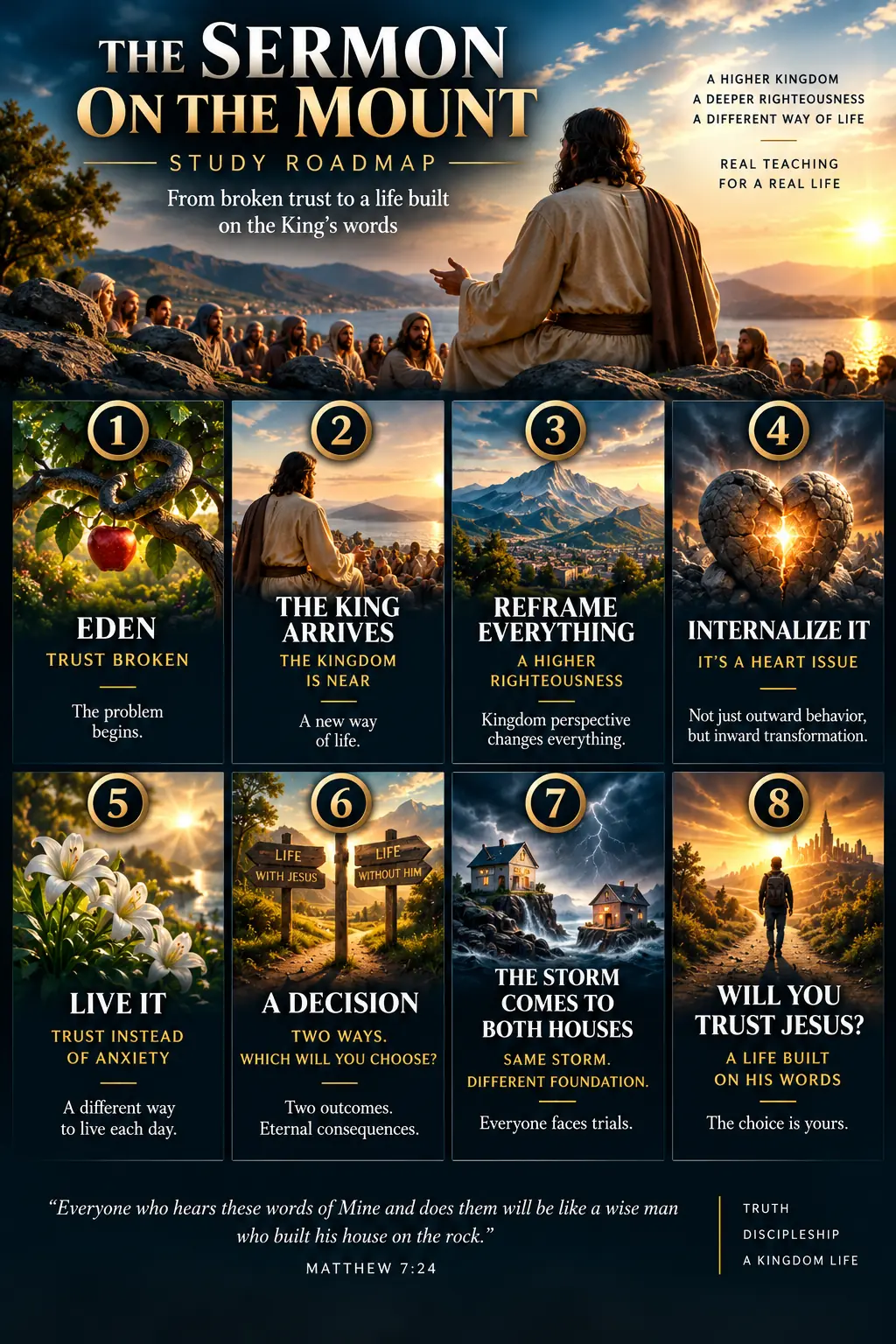
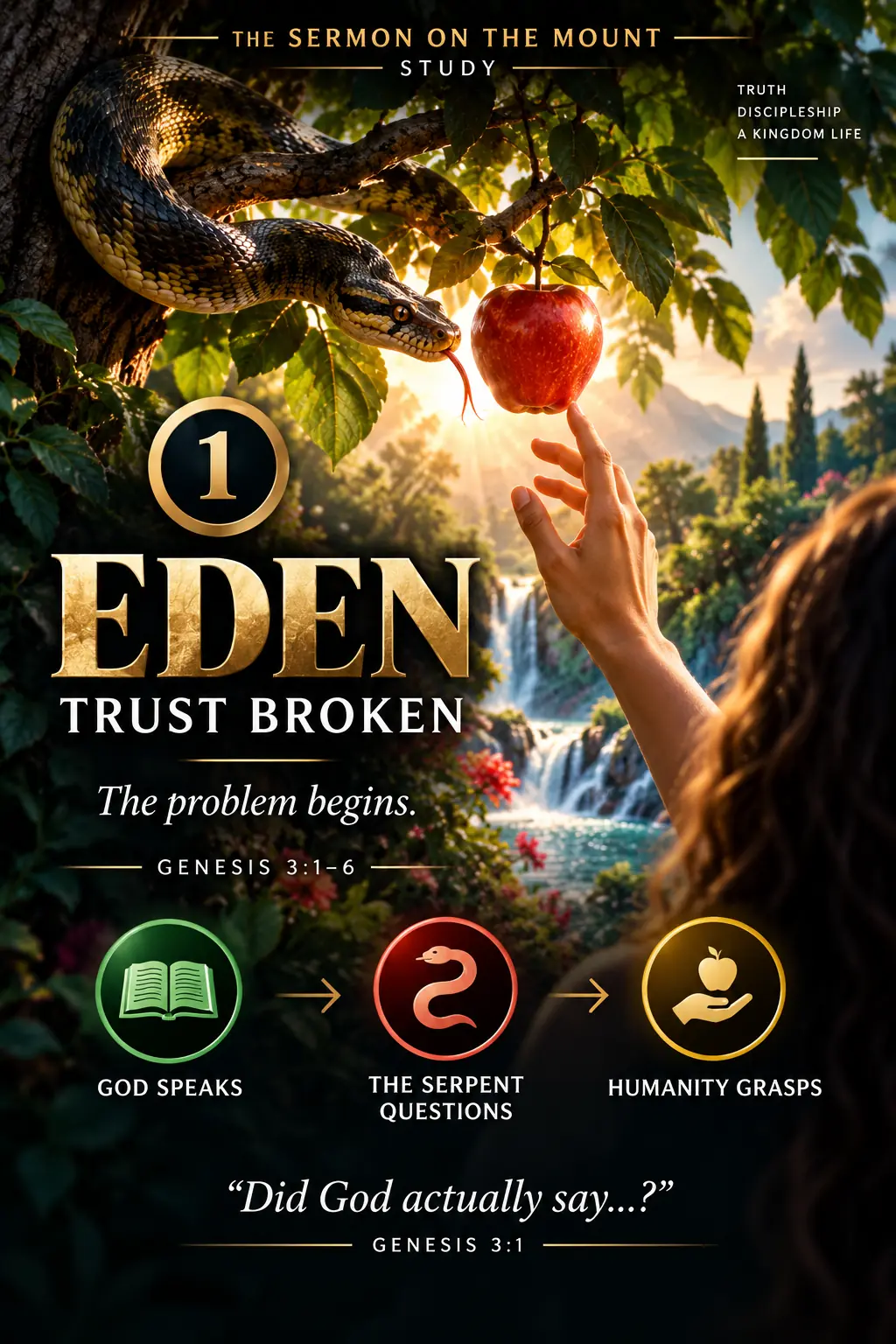
THE ORIGINAL KINGDOM
In the beginning, humanity lived under the rule of God. God was King. Adam and Eve lived in His presence, received life from Him, and depended upon Him for what they needed. There was no anxiety about tomorrow, no accumulation of possessions for security, and no struggle to establish an identity apart from God.
Human beings were created to live in dependence upon God. They were created to trust Him.
God gave Adam one prohibition: he was not to eat from the tree of the knowledge of good and evil (Genesis 2:16–17). Then the serpent entered the story, and notice what he attacked.
“Did God actually say…?” — Genesis 3:1
Then the serpent directly contradicted what God had said: “You will not surely die” (Genesis 3:4). Finally, he suggested that God knew something good would happen if they ate: “You will be like God, knowing good and evil” (Genesis 3:5).
The temptation involved forbidden fruit, but something much deeper was happening. The serpent was attacking trust. The insinuation was that God was not telling them the truth, that God was withholding something good from them, and therefore that God could not completely be trusted.
Adam and Eve believed the lie. Instead of receiving from God, they grasped. Instead of trusting God's judgment about good and evil, they chose for themselves. Dependence upon God gave way to self-reliance, followed by shame, fear, hiding, blame, and eventually death.
Certainly the Fall was an act of disobedience. But beneath that disobedience was a catastrophic failure of trust and allegiance. Humanity stopped trusting God, and the rest of the biblical story unfolds in the broken world that followed.
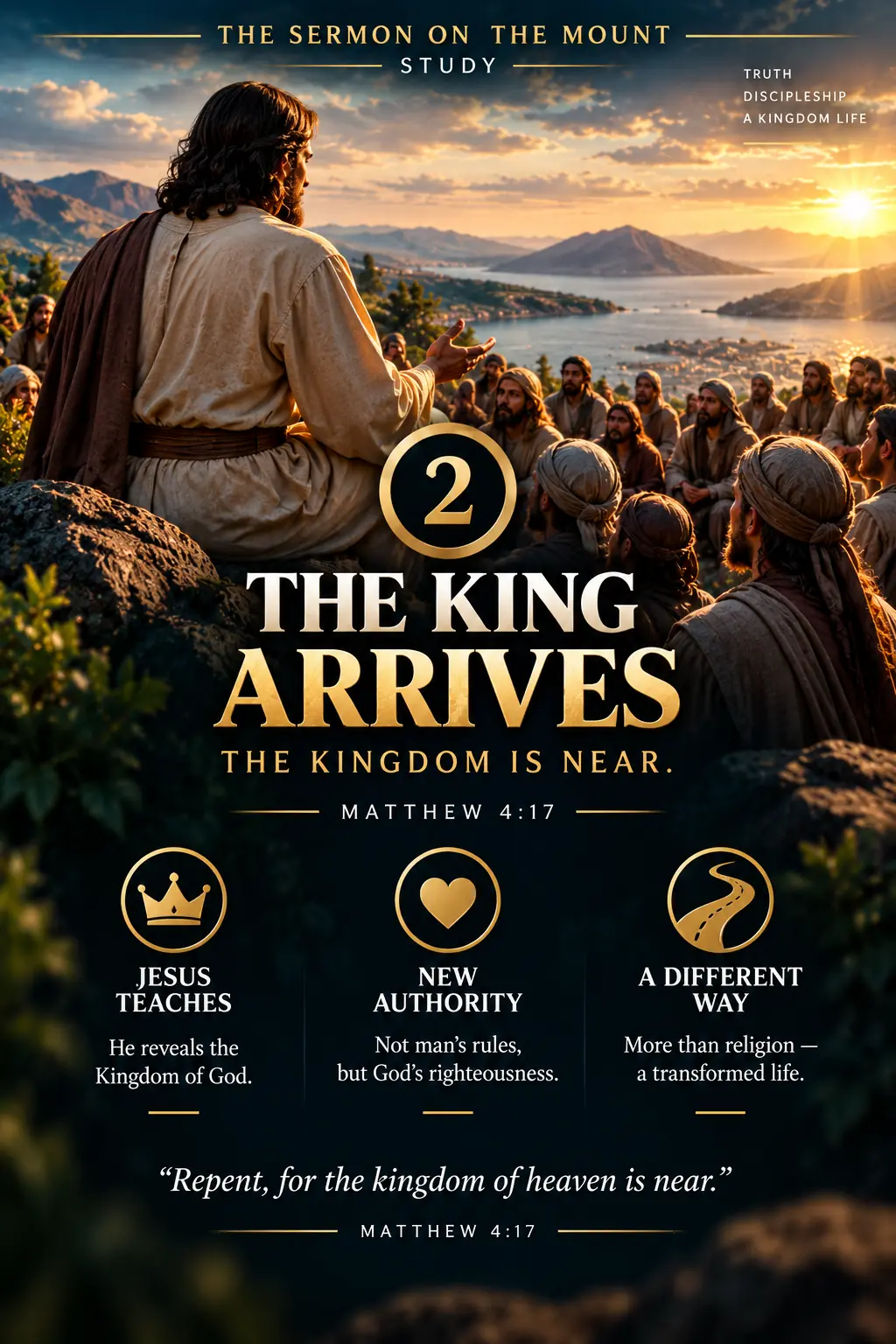
THEN THE KING COMES
Thousands of years later, Jesus arrives announcing:
“Repent, for the kingdom of heaven is at hand.” — Matthew 4:17, ESV
The King has come, and the Kingdom has drawn near. But God’s Kingdom has not yet reached its complete fulfillment. We still live in a fallen world where sin, suffering, and death remain.
That makes the Sermon on the Mount a message for people living between the arrival of the King and the full arrival of His Kingdom. Jesus teaches His followers how to live under God’s reign now while trusting Him concerning what is still to come.
Running underneath everything Jesus teaches is the same question raised in Eden:
Will you trust God?
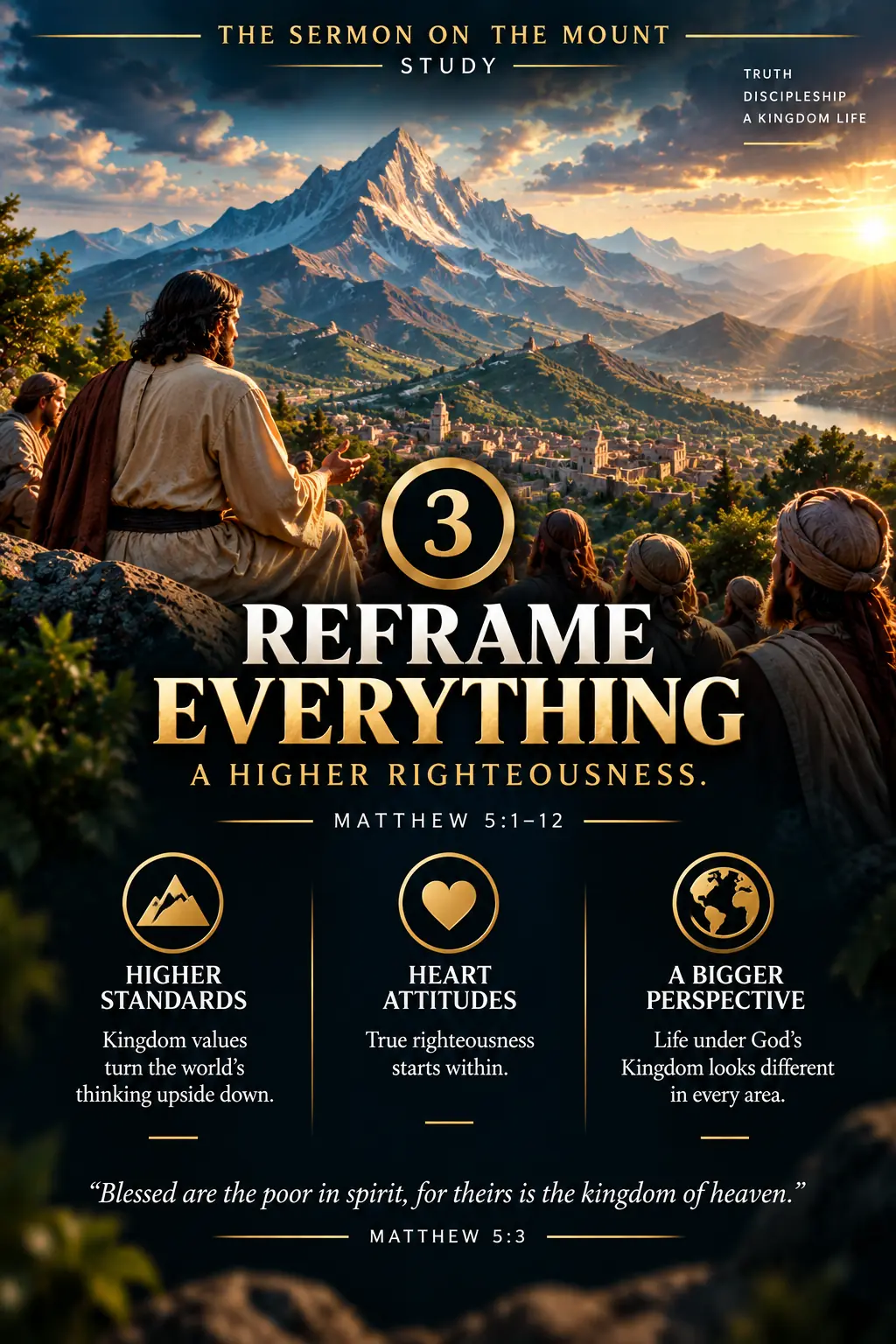
PART ONE — REFRAME EVERYTHING
The Upside-Down Kingdom — or the Right-Side-Up Kingdom
THE KINGDOM BEFORE THE SERMON
Before Jesus ever sits down on the mountain, Matthew has already told us how to understand what is happening. Jesus has begun His public ministry with the announcement, “Repent, for the kingdom of heaven is at hand” (Matthew 4:17, ESV). Then Matthew summarizes what Jesus has been doing throughout Galilee:
“And he went throughout all Galilee, teaching in their synagogues and proclaiming the gospel of the kingdom and healing every disease and every affliction among the people.” — Matthew 4:23, ESV
Matthew gives us a clear three-part pattern.
1. TEACHING IN THEIR SYNAGOGUES — THE WORD
Jesus is teaching God’s revealed truth. He is not merely appearing as a miracle worker or attracting attention through supernatural displays. His ministry is grounded in teaching. The Word comes first.
2. PROCLAIMING THE GOSPEL OF THE KINGDOM — THE ANNOUNCEMENT
Jesus is announcing good news about the Kingdom of God. The King has arrived, and therefore the Kingdom has drawn near. The Sermon on the Mount does not appear out of nowhere as a collection of moral teachings. Before Jesus ever says, “Blessed are…,” Matthew has placed the Sermon in an explicitly Kingdom-centered context.
3. HEALING AND DELIVERING — THE KING’S POWER AND AUTHORITY DISPLAYED
Matthew then expands the picture. News about Jesus spreads, and people bring Him “all the sick, those afflicted with various diseases and pains, those oppressed by demons, those having seizures, and paralytics, and he healed them” (Matthew 4:24, ESV).
Jesus is not merely talking about the Kingdom. He is demonstrating the authority of its King. Disease yields to Him. Paralysis yields to Him. Demons yield to Him. The miraculous signs confirm and display God’s power at work through Jesus and demonstrate His extraordinary authority over the brokenness of the fallen world.
These healings and deliverances are real historical miracles, but they also give the people visible previews of restoration. A paralyzed person walks. A sick person becomes well. A person oppressed by a demon is delivered. The broken condition of the present world is not beyond the authority of this King.
This does not mean the Kingdom has already arrived in its complete earthly form. People still become sick. People still die. Demonic opposition continues. Rome still rules. Rather, Jesus’ miracles display the power and authority of the King and give a foretaste of the restoration His reign will ultimately bring.
The sequence leading into the Sermon is therefore important:
TEACHING THE WORD → ANNOUNCING THE KINGDOM → DEMONSTRATING THE KING’S POWER AND AUTHORITY → THE CROWDS GATHER → THE DISCIPLES COME TO JESUS → THE KING SITS DOWN TO TEACH HIS FOLLOWERS.
The people approaching the mountain have heard the Kingdom announced and have seen the King’s authority demonstrated. Then Jesus sits down to explain what life under God’s rule actually looks like.
That makes the promises Jesus is about to make even more striking. The One who is about to make extraordinary promises about comfort, inheritance, righteousness, and the Kingdom has just demonstrated extraordinary authority over sickness, disease, paralysis, and demons.
He has announced that the Kingdom has drawn near. He has displayed the power of the King. Now He begins to teach His followers what His Kingdom is like.
BEFORE JESUS SAYS “BLESSED…”
Matthew carefully establishes the setting before Jesus begins the Sermon. Jesus has been proclaiming “the gospel of the kingdom” (Matthew 4:23), healing throughout Galilee, and attracting enormous crowds. Matthew 4:25 says that great crowds followed Him from Galilee, the Decapolis, Jerusalem, Judea, and beyond the Jordan.
Then Matthew narrows the focus:
“Seeing the crowds, he went up on the mountain, and when he sat down, his disciples came to him. And he opened his mouth and taught them, saying:” — Matthew 5:1–2, ESV
The crowds have not disappeared. At the end of the Sermon, Matthew says “the crowds were astonished at his teaching” (Matthew 7:28). They were apparently listening. But Matthew specifically tells us that Jesus sat down, His disciples came to Him, and He taught them.
That matters. This is the King teaching His followers how to understand reality and live as people who belong to His Kingdom.
And His opening words must have been startling.
WHAT ARE THE BEATITUDES?
The opening statements of the Sermon on the Mount in Matthew 5:3–12 are commonly called the Beatitudes. The name comes from a Latin word associated with blessedness. Each Beatitude begins with Jesus declaring someone “blessed” and then explaining why.
But the Beatitudes are not simply eight inspirational sayings about how to be happy. Jesus is announcing God’s assessment of who is truly blessed—and His assessment often appears completely upside down compared with the values of the present world. That makes the Beatitudes the perfect opening to Jesus’ teaching about the Kingdom.
“BLESSED ARE…”
Jesus begins by declaring who is truly blessed. “Blessed” cannot simply mean happy, because some of the people Jesus calls blessed are mourning or being persecuted. Their immediate circumstances may be painful. Jesus is giving God’s assessment of their true condition.
That immediately challenges the disciples to decide whose evaluation of reality they will believe. The fallen world looks at circumstances and decides who is winning and who is losing. Jesus says, in effect: Let Me tell you who is actually blessed.
And the promises attached to the Beatitudes immediately raise another question:
WHEN?
Many of the promises Jesus makes are not completely visible in the world His disciples are presently experiencing. That is deliberate.
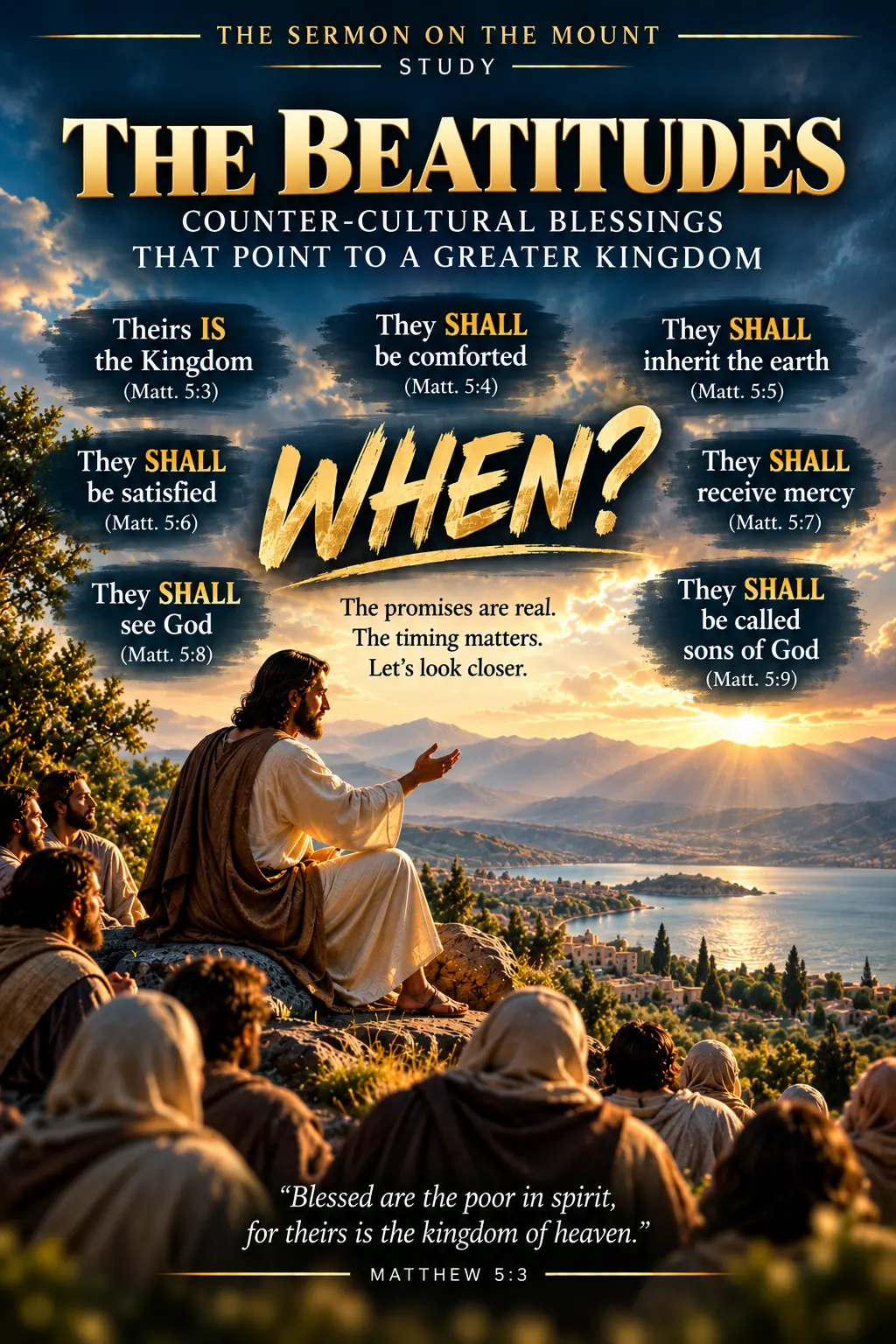
1. BLESSED ARE THE POOR IN SPIRIT
“Blessed are the poor in spirit, for theirs is the kingdom of heaven.” — Matthew 5:3, ESV
Jesus begins with spiritual poverty. This is not simply a celebration of material poverty. The person who is poor in spirit recognizes his spiritual need before God. He does not approach the King boasting about what he possesses or deserves.
That is already contrary to the fallen world’s instinct toward self-sufficiency. The world says: Establish yourself. Prove yourself. Depend upon yourself. Jesus begins Kingdom teaching with someone who comes before God knowing: I need You.
WHEN DO THEY GET THE KINGDOM?
Notice that Jesus does not say, “theirs will be the kingdom of heaven.” He says, “theirs is the kingdom of heaven” (Matthew 5:3, ESV).
So the hearer naturally asks: When do I get the Kingdom of Heaven?
The answer is both now and later.
The King is already standing among them. Jesus has announced that the Kingdom has drawn near. Those who belong to the King already belong to His Kingdom and already begin living under His rule.
But look around. Rome still rules the land. Sin, sickness, demonic opposition, injustice, suffering, and death remain. The world has clearly not yet been brought fully under the righteous rule of the King.
The King is here, so His Kingdom has begun. But the King has not yet returned to rule the whole earth.
This is sometimes called the “already/not-yet” Kingdom.
ALREADY: The King has come. His followers belong to Him. They live under His rule and begin experiencing Kingdom life now.
NOT YET: Jesus has not yet returned to establish the Messianic Kingdom—the promised earthly reign of Jesus the Messiah, when He returns to rule as King. The whole world is not yet living under His rule, and the final restoration of creation still lies beyond that.
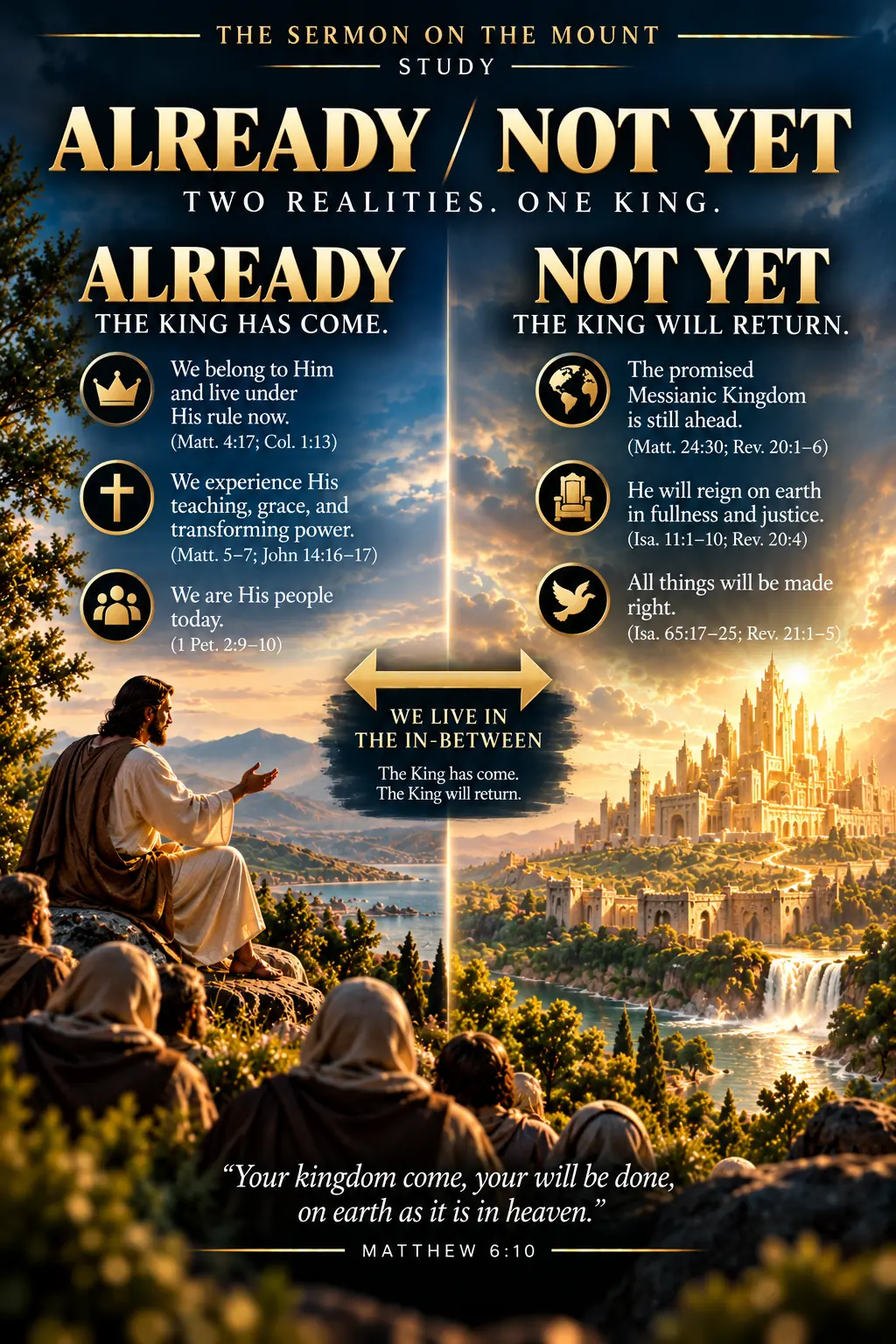
That distinction is essential for understanding the Sermon on the Mount. Jesus is teaching people who already belong to the Kingdom how to live while they wait for the Kingdom to come in its fullness.
This also gives us a framework for the Beatitudes that follow. Some Kingdom realities are experienced now. Others await the King’s return and His Messianic reign. And some reach their complete fulfillment only in the final new creation.
2. BLESSED ARE THOSE WHO MOURN
“Blessed are those who mourn, for they shall be comforted.” — Matthew 5:4, ESV
Now the future tense becomes explicit: they shall be comforted.
When?
God certainly comforts His people now, but Jesus’ promise reaches beyond temporary relief in difficult circumstances. His disciples still suffered, experienced persecution, and died. The fallen world remained fallen. The promise therefore creates expectation. There is coming a world in which the King will deal with what presently causes His people to mourn.
The disciple can mourn with hope because he trusts the King concerning what is coming.
3. BLESSED ARE THE MEEK
“Blessed are the meek, for they shall inherit the earth.” — Matthew 5:5, ESV
Again the question is unavoidable: When?
The meek did not immediately inherit the earth during Jesus’ earthly ministry. Rome still ruled. The disciples did not take possession of the nations after Pentecost. Jesus does not merely promise them an inward sense of peace. He says they shall inherit the earth.
Jesus is drawing directly from Psalm 37:
“But the meek shall inherit the land and delight themselves in abundant peace.” — Psalm 37:11, ESV
The larger argument of Psalm 37 is especially important. The psalm begins, “Fret not yourself because of evildoers” (Psalm 37:1). Then it says, “Trust in the LORD, and do good” (Psalm 37:3), and, “Commit your way to the LORD; trust in him, and he will act” (Psalm 37:5).
The wicked may appear to prosper, but their success is temporary. God tells His people not to envy them, imitate them, or become anxious because of what they see. Instead, they are to trust the LORD and continue doing good. God will act. The wicked will not possess the land forever; those who trust the LORD will inherit it.
That is the promise Jesus reaches back to when He says, “Blessed are the meek, for they shall inherit the earth.”
Matthew 5:5 therefore does not merely fit the trust theme of the Sermon; its Old Testament foundation reinforces it.
When we follow this promise through the rest of Scripture, inheriting the earth points naturally toward the coming reign of Messiah on the earth. The King is telling His disciples: You do not have to seize the world. Trust Me. I am going to give you an inheritance in My Kingdom.
4. BLESSED ARE THOSE WHO HUNGER AND THIRST FOR RIGHTEOUSNESS
“Blessed are those who hunger and thirst for righteousness, for they shall be satisfied.” — Matthew 5:6, ESV
In this context, righteousness means what is right according to God’s character and rule.
Again: When?
Jesus’ disciples lived in an unrighteous world, and so do we. We see injustice, wickedness, corruption, suffering, exploitation, violence, deception, and rebellion against God. Someone who genuinely hungers for righteousness can look around and feel perpetually unsatisfied.
Jesus says that hunger will be satisfied. Christ’s followers can begin living righteously now, but the world Jesus promises—where righteousness marks life under God’s rule—is still coming. The prophets had already described a coming Davidic King whose reign would be characterized by righteousness and justice.
The disciple’s hunger is not foolish. The King says it will be satisfied. Again, trust.
5. BLESSED ARE THE MERCIFUL
“Blessed are the merciful, for they shall receive mercy.” — Matthew 5:7, ESV
Again Jesus gives a promise that points forward: “they shall receive mercy.”
When?
God’s people experience His mercy now. We live every day as people dependent upon mercy we did not earn. But Jesus’ future wording also directs the disciple toward what is still ahead.
That matters because showing mercy can be costly in the present world. The fallen instinct says: Make them pay. Get even. Make sure the wrong is repaid. Jesus says: Be merciful.
Why can a Kingdom disciple live that way? Because he trusts the King. He does not have to seize final justice for himself. He can extend mercy now while trusting God to settle things rightly in the end.
This anticipates what Jesus will teach later about reconciliation, loving enemies, refusing personal retaliation, and forgiving others.
But mercy does not purchase entrance into the Kingdom. Jesus is not teaching salvation by works. Rather, mercy is characteristic of people who themselves live under God’s mercy.
Kingdom people can show mercy now because they trust the Father to show mercy and bring perfect justice in the end.
6. BLESSED ARE THE PURE IN HEART
“Blessed are the pure in heart, for they shall see God.” — Matthew 5:8, ESV
The promise is staggering: they shall see God.
When?
There is a present reality of knowing God and walking with Him, but “they shall see God” reaches forward. The biblical story begins with humanity living in God’s presence and ends with restored humanity again dwelling in His presence.
Here our Eden connection appears again. Humanity was expelled from God’s presence because of sin. Jesus announces a Kingdom in which the pure in heart will see God. The story is moving toward restoration.
7. BLESSED ARE THE PEACEMAKERS
“Blessed are the peacemakers, for they shall be called sons of God.” — Matthew 5:9, ESV
Again Jesus points forward: “they shall be called sons of God.”
When?
And the phrase itself deserves our attention. In the Old Testament, the exact “sons of God” language is especially associated with heavenly beings in passages such as Job 1:6, Job 2:1, and Job 38:7.
The Old Testament also uses related sonship language for Israel—Israel is God’s son, and Israelites can be described as His sons or as “sons of the living God” (Exodus 4:22; Deuteronomy 14:1; Hosea 1:10).
So the idea of human beings belonging to God as His children is not absent from the Old Testament. But Jesus’ direct promise that ordinary human peacemakers “shall be called sons of God” is still striking.
Within the larger biblical story, there is a powerful reversal here. The Old Testament portrays rebellious heavenly sons of God who fail in their allegiance to the Most High. Jesus now speaks of faithful human beings who reflect the Father’s character and says that they will be called sons of God. The rebellious spiritual powers do not get the last word. The King is forming a human family that bears the Father’s character.
Jesus will shortly tell His disciples to love their enemies and pray for those who persecute them because their Father gives sun and rain to both the evil and the good (Matthew 5:44–45). Peacemaking therefore reflects the character of the Father.
In a violent and divided world, peacemaking may look weak or foolish. Jesus says otherwise. Those who belong to His Kingdom can make peace now because their identity is secured by God, not by winning every present conflict.
And again the future wording matters: “they shall be called sons of God.” The King is telling His followers that the world’s present judgment is not the final word about who they are. God will identify them as His own.
8. BLESSED ARE THOSE WHO ARE PERSECUTED
“Blessed are those who are persecuted for righteousness’ sake, for theirs is the kingdom of heaven.” — Matthew 5:10, ESV
Here Jesus returns to the present tense with which He began the Beatitudes: “theirs is the kingdom of heaven.” The first and eighth Beatitudes therefore form a kind of bookend around the promises between them.
So when do the persecuted receive the Kingdom?
The answer is the same already/not-yet reality we saw with the poor in spirit. They belong to the Kingdom now because they belong to the King, even while the world may reject and persecute them. Yet they have not experienced the Kingdom in its fullness.
Then Jesus makes the promise personal and aims directly at His disciples: “Blessed are you when others revile you and persecute you…” (Matthew 5:11, ESV). He tells them to rejoice because their reward is great in heaven (Matthew 5:12).
If blessing is defined by present circumstances, persecution means something has gone terribly wrong. Jesus says the opposite. A disciple can suffer precisely because he is faithful to the King and still be blessed.
That only makes sense if Jesus knows something about reality that the disciple cannot presently see. He does.
THE QUESTION RUNNING THROUGH THE BEATITUDES: WHEN?
After hearing these promises, the disciple is forced to look forward. When will those who mourn finally be comforted? When will the meek inherit the earth? When will the hunger for righteousness finally be satisfied? When will God’s people live openly under the righteous rule of the King? When will promises that seem upside down in this present age become visible reality?
The Kingdom is already present because the King has come and His followers already belong to Him. But we have not yet experienced the Kingdom Jesus describes in its fullness.
These promises point forward to the literal future Messianic Kingdom, when Jesus returns and reigns upon the earth. But that does not mean every promise in the Beatitudes is completely fulfilled by the end of the Millennium. Some reach even farther—to resurrection and the final new creation, when sin, death, and the curse are finally gone.
The point is that these promises cannot be completely fulfilled in the world as it is now. Jesus points His disciples toward the Kingdom that is coming and calls them to live according to its reality now.
TRUST THE KING NOW BECAUSE YOU BELIEVE HIM ABOUT THE KINGDOM THAT IS COMING
This is what Jesus has been doing throughout Part One. Jesus teaches His disciples to trust the future enough to live differently in the present.
The world says: Take what you can now. Jesus says the meek will inherit the earth. The world says: Avoid suffering at all costs. Jesus says those who mourn will be comforted. The world says: Righteousness does not win. Jesus says your hunger for righteousness will be satisfied. The world says: Persecution means you are losing. Jesus says you are blessed.
Every one of those claims demands the same response: Do I trust the King enough to believe His description of reality when I cannot yet see it?
That is why the Beatitudes are the perfect opening to the Sermon on the Mount. Jesus does not wander into the issue of trust later in Matthew 6. He begins there.
The very first thing He asks His disciples to do is believe Him about a Kingdom they cannot yet fully see—and then live now as though the King is telling them the truth.
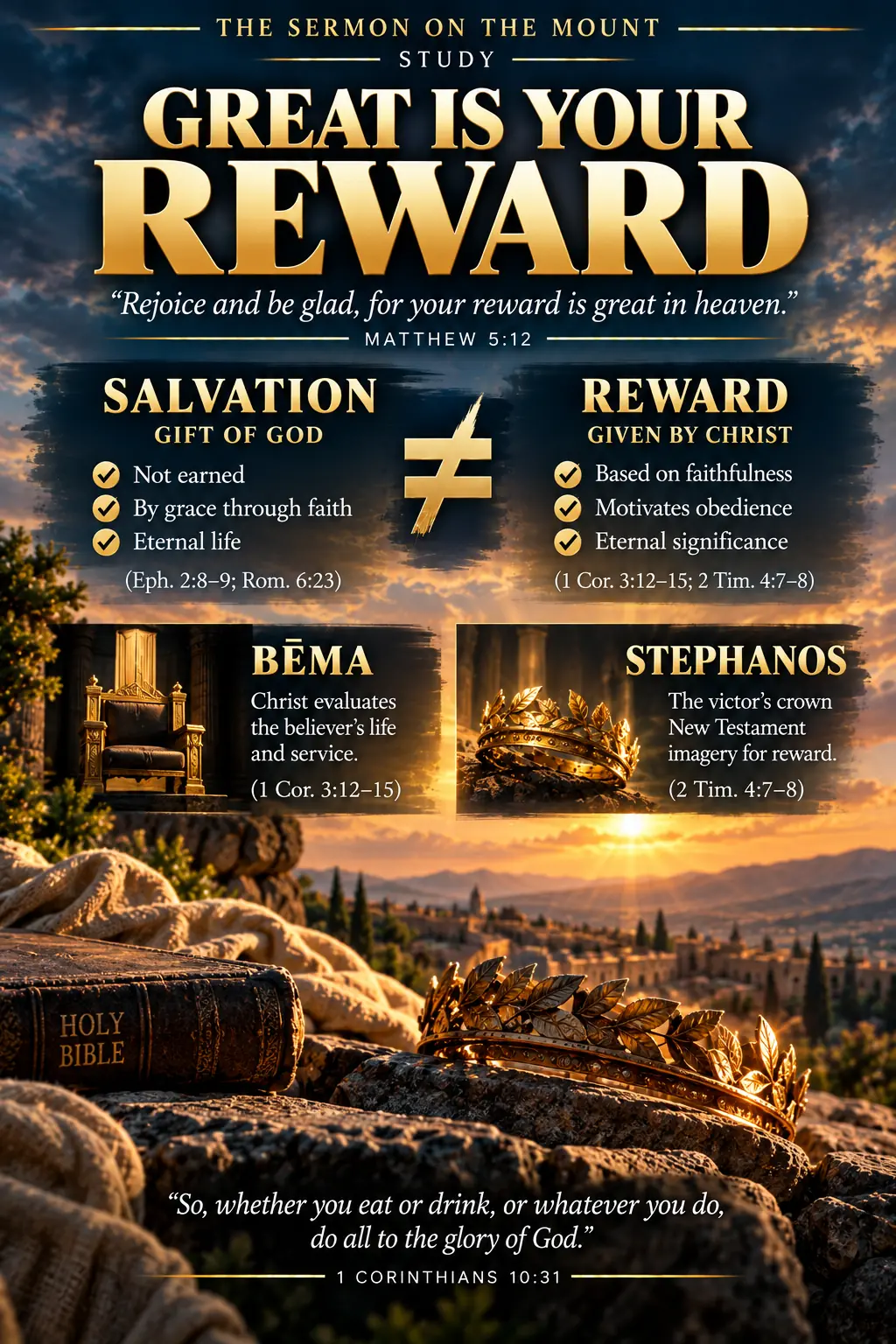
A NEW THREAD: REWARD
At the end of the Beatitudes, Jesus introduces another idea that will continue through the Sermon: reward.
“Rejoice and be glad, for your reward is great in heaven, for so they persecuted the prophets who were before you.” — Matthew 5:12, ESV
This adds another part to the question “When?” Jesus tells disciples who may suffer now that what is happening to them is not the end of the story. Their faithfulness will be rewarded.
Jesus is not saying that we earn salvation by doing good works. Salvation is a gift. Rewards are different. Jesus is telling His followers that how we live now matters—and that faithfulness to Him will be rewarded.
That requires trust. The fallen impulse says: I need my good now. I need recognition now. I need security now. Jesus teaches His disciples that they can wait because they trust their Father and believe the King about what is coming.
Kingdom people can give up a reward they can see now because they trust the Father for a greater reward they cannot yet see.
Jesus will return to this idea repeatedly in the next part of the Sermon.
GOING DEEPER — WHAT THE NEW TESTAMENT LATER REVEALS ABOUT REWARDS
Jesus’ references to reward are not isolated figures of speech. The later New Testament continues to teach that followers of Christ will be evaluated for their faithfulness and can receive real reward. Salvation and reward must remain distinct: believers do not work to earn salvation, but saved people are called to faithful obedience and service.
Paul makes the distinction especially clear in 1 Corinthians 3:14–15. If a believer’s work survives testing, “he will receive a reward.” If the work is burned up, “he will suffer loss, though he himself will be saved” (ESV). The person remains saved, but reward can be received or lost.
THE BEMA — AN ACCOUNTING BEFORE CHRIST
Paul also writes, “For we must all appear before the judgment seat of Christ” (2 Corinthians 5:10, ESV). The Greek word translated “judgment seat” is bēma. This is not presented as believers earning heaven rather than hell. Christ will evaluate how believers lived and served Him. Romans 14:10–12 likewise says that each of us will give an account to God.
STEPHANOS — THE VICTOR’S CROWN
The New Testament also uses the image of the stephanos—a crown or victor’s wreath. Paul speaks of an imperishable wreath (1 Corinthians 9:25), a “crown of boasting” (1 Thessalonians 2:19), and a “crown of righteousness” (2 Timothy 4:8). James and Revelation speak of the “crown of life” (James 1:12; Revelation 2:10), and Peter speaks of the “unfading crown of glory” (1 Peter 5:4).
The New Testament uses this crown imagery in several ways, so we should not assume every reference names a completely different kind of reward. But Jesus’ language about reward should not be reduced to something vague. The coming Kingdom is real, and the rewards Jesus promises are real.
Jesus is teaching His disciples to choose the right reward. Human applause, possessions, status, and comfort can be gained now and lost. The Father sees what is done in faithfulness, and Christ will evaluate His servants.
So the question becomes: What reward am I working for?
Kingdom people can surrender a reward they can see now because they trust the King concerning the real reward that is still to come.
SALT AND LIGHT — FUTURE KINGDOM, PRESENT RESPONSIBILITY
Immediately after Jesus tells His disciples, “your reward is great in heaven” (Matthew 5:12, ESV), He turns to their responsibility in the present world. The Beatitudes are not passive promises. Jesus does not tell His followers simply to wait for the coming Kingdom and its rewards. Because they belong to the Kingdom, they have work to do now.
“You are the salt of the earth, but if salt has lost its taste, how shall its saltiness be restored? It is no longer good for anything except to be thrown out and trampled under people’s feet.” — Matthew 5:13, ESV
Jesus’ warning is severe. Salt that fails to do what salt is supposed to do is “no longer good for anything.” The point is usefulness and faithfulness. What good is a Kingdom disciple who refuses to live like a Kingdom disciple?
This is not a teaching that disciples earn salvation by becoming useful enough. Jesus is speaking to His followers. The issue is whether people who belong to the King will faithfully carry out the purpose He has given them.
Then Jesus changes the picture:
“You are the light of the world. A city set on a hill cannot be hidden.” — Matthew 5:14, ESV
Jesus continues, “Nor do people light a lamp and put it under a basket” (Matthew 5:15, ESV). Lighting a lamp and then deliberately hiding it defeats the purpose of the lamp. In the same way, disciples are not called to an invisible Christianity that has no effect upon the world around them.
Jesus concludes:
“In the same way, let your light shine before others, so that they may see your good works and give glory to your Father who is in heaven.” — Matthew 5:16, ESV
The future Kingdom does not make present life unimportant. It makes present faithfulness more important. Jesus has promised His followers a future Kingdom and future reward, and then immediately tells them to live faithfully now.
FUTURE KINGDOM → FUTURE REWARD → PRESENT RESPONSIBILITY
The disciple does not work in order to earn entrance into the Kingdom. The disciple works because he belongs to the King. Good works are part of living now according to the reality of the Kingdom that is coming.
WHO GETS THE GLORY?
Matthew 5:16 also prepares us for something Jesus will address directly in Matthew 6. Here Jesus tells His disciples to let people see their good works. Yet in Matthew 6:1 He warns them against practicing righteousness before other people “in order to be seen by them” (ESV).
There is no contradiction. The difference is the purpose of the heart.
In Matthew 5, people see the disciple’s good works and “give glory to your Father who is in heaven.” In Matthew 6, the person performs righteous acts in order to receive attention and approval for himself. One points attention toward the Father. The other seeks attention for the disciple.
Jesus is not teaching hidden Christianity. He is confronting self-glorifying Christianity.
This creates a natural bridge into the Inside-Out Kingdom. Jesus has told His followers that their lives and good works should be visible. Now He will go deeper. He will examine righteousness itself, and eventually even the motives behind apparently righteous behavior.
The sequence is becoming clear: the Kingdom is coming, the King promises real future reward, and His disciples therefore have real responsibilities now. They are to be useful salt, visible light, and people whose good works cause others to glorify their Father.
The Kingdom is coming. You belong to it already. Now live like it.
THE LAW AND THE PROPHETS — THE LONG-RANGE FORECAST
After telling His disciples that they are salt and light, Jesus makes clear that His Kingdom teaching does not abolish the Scriptures that came before Him.
“Do not think that I have come to abolish the Law or the Prophets; I have not come to abolish them but to fulfill them.” — Matthew 5:17, ESV
Jesus has not come to throw away the Law and the Prophets or replace God’s earlier revelation with an unrelated program. He has come to fulfill what they have been pointing toward.
Then Jesus looks far into the future:
“For truly, I say to you, until heaven and earth pass away, not an iota, not a dot, will pass from the Law until all is accomplished.” — Matthew 5:18, ESV
Notice the two “untils”: until heaven and earth pass away, and until all is accomplished.
This is another answer to the question raised by the Beatitudes: When?
Jesus has already promised that those who mourn will be comforted, the meek will inherit the earth, those who hunger and thirst for righteousness will be satisfied, and His persecuted followers will receive reward. Now He pulls the camera back and gives a long-range forecast. God’s revealed purposes will not fail. The Scriptures will not simply be discarded. The promises will not be forgotten. Jesus has come to fulfill them, and the story continues until all is accomplished.
Jesus does not spell out the entire prophetic timeline in this one verse. But when we follow the rest of Scripture, we can see where the story is headed. The Law and the Prophets tell a much larger story than the events of Jesus’ first coming alone. They point toward the Messiah, His saving work, God’s purposes for Israel and the nations, judgment, restoration, resurrection, the reign of the King, and the fulfillment of God’s promises.
The cross and resurrection are central to that fulfillment, but many prophetic promises still awaited fulfillment after Jesus rose from the dead.
Jesus looks all the way ahead to the passing away of the present heaven and earth. Later Scripture describes that final transition: “Then I saw a new heaven and a new earth, for the first heaven and the first earth had passed away” (Revelation 21:1, ESV).
So the biblical story stretches from the King’s first coming, through His saving work and the present age, to His return and literal Messianic reign, and finally to the new creation when the present heaven and earth pass away.
Some Kingdom promises are experienced in part now. Others await their fulfillment in the coming Messianic Kingdom. The whole story finally reaches its completion in the new heaven and new earth. Jesus’ point is that God will accomplish what He has revealed.
TRUST GOD’S WORD — HE WILL ACCOMPLISH IT
This strengthens the trust theme running through the Sermon. Jesus is telling His disciples that God’s Word can be trusted down to the smallest detail. Not an iota. Not a dot. God is not abandoning His promises, and Jesus is not canceling them. He is fulfilling them.
The progression of Part One is now unmistakable. Trust the King’s definition of blessing. Trust His promises about the coming Kingdom. Trust Him concerning future reward. Live faithfully now as salt and light. And trust God’s Word because every purpose He has revealed will ultimately be accomplished.
That also prepares us for what Jesus says next. When He begins, “You have heard that it was said…,” He has already made clear that He is not abolishing Scripture. He is about to take His disciples deeper into the righteousness God requires, moving from outward behavior toward the heart.
That is the transition from the right-side-up Kingdom into the inside-out Kingdom.
SO FAR…
Jesus has asked His disciples to believe Him about a Kingdom they cannot yet fully see. The question is trust. Now He turns inward: What kind of people should Kingdom citizens become?
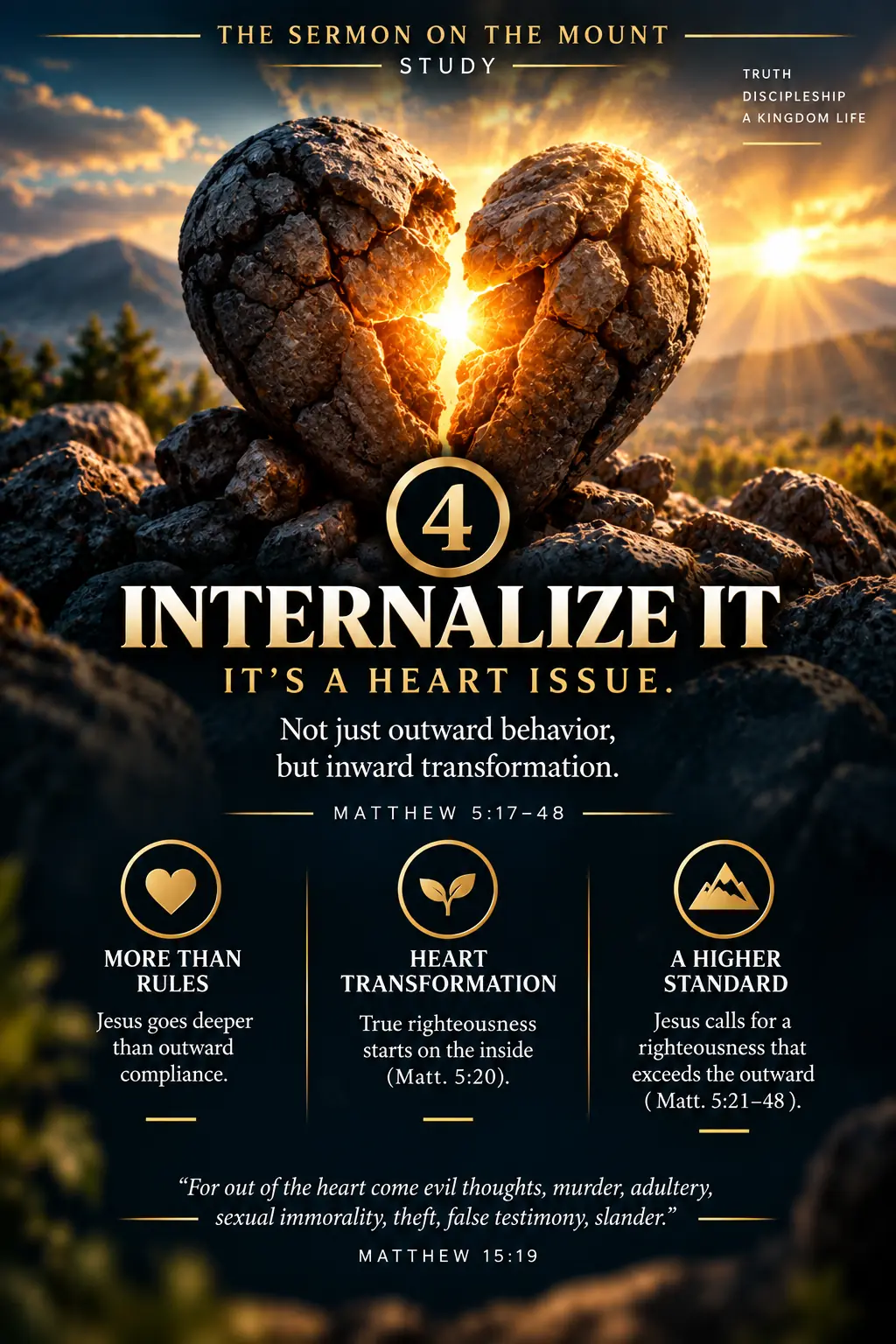
PART TWO — INTERNALIZE IT
The Inside-Out Kingdom
GOD REQUIRES MORE THAN YOU THOUGHT
Jesus has just made something unmistakably clear: He has not come to abolish the Law or the Prophets. He has come to fulfill them. That protects us from misunderstanding the pattern that follows.
Again and again Jesus says some form of: “You have heard that it was said…” and then, “But I say to you…” He is not declaring that God’s earlier revelation was wrong and that He has come to replace it with something unrelated. God’s Law revealed His righteous standard. Jesus, the authoritative King, now reveals the full depth of the righteousness God requires.
The disciples may have thought righteousness was mainly about obeying the rules on the outside. Jesus keeps taking them beneath the visible act and exposing the heart from which the act comes.
This is the Inside-Out Kingdom.
MURDER — WHAT ABOUT YOUR ANGER?
“You have heard that it was said to those of old, ‘You shall not murder; and whoever murders will be liable to judgment.’ But I say to you…” — Matthew 5:21–22, ESV
It is not enough simply to say, “I have never murdered anyone.” Jesus goes beneath the final violent act and confronts anger, contempt, and broken relationships. Kingdom righteousness reaches into the heart long before anger becomes murder.
Jesus even stresses reconciliation. A person coming to offer a gift at the altar who remembers that his brother has something against him is told to pursue reconciliation (Matthew 5:23–24). God is not interested in religious performance that ignores what is happening in our relationships.
ADULTERY — WHAT ABOUT YOUR HEART?
“You have heard that it was said, ‘You shall not commit adultery.’ But I say to you…” — Matthew 5:27–28, ESV
Again Jesus goes beneath the outward act. A person may be able to claim that he has never physically committed adultery while allowing lust to rule his eyes and imagination. Jesus exposes the heart behind the act.
Kingdom righteousness cannot be reduced to staying technically outside the boundary of a prohibited behavior. God sees what is happening inside us.
DIVORCE — MORE THAN A LEGAL DOCUMENT
“It was also said, ‘Whoever divorces his wife, let him give her a certificate of divorce.’” — Matthew 5:31, ESV
Jesus goes beyond treating the existence of a divorce certificate as though it settles the entire moral question. Jesus looks beyond the legal document to the breaking of the marriage covenant and the harm it causes. Once again, simply following the legal requirement is not enough to show whether a person’s conduct reflects the righteousness of God.
OATHS — WHY SHOULDN’T YOUR WORD ALWAYS BE TRUSTWORTHY?
“Again you have heard that it was said to those of old, ‘You shall not swear falsely, but shall perform to the Lord what you have sworn.’ But I say to you…” — Matthew 5:33–34, ESV
Jesus goes deeper than a system that asks which oath is technically binding. Kingdom people should possess such basic truthfulness and integrity that elaborate guarantees are unnecessary.
“Let what you say be simply ‘Yes’ or ‘No’…” — Matthew 5:37, ESV
The deeper question is not merely whether you kept a particular oath. Can people trust what comes out of your mouth?
RETALIATION — WHAT ABOUT YOUR RIGHT TO GET EVEN?
“You have heard that it was said, ‘An eye for an eye and a tooth for a tooth.’ But I say to you…” — Matthew 5:38–39, ESV
The Old Testament principle placed limits upon justice; it was not permission for unlimited personal revenge. Jesus now confronts the disciple’s desire to retaliate and insist upon personal repayment. He teaches His followers to be willing to surrender personal rights rather than be controlled by revenge.
Again, Jesus is reaching beneath behavior to the heart. What happens inside you when someone wrongs you?
LOVE — EVEN YOUR ENEMIES
“You have heard that it was said, ‘You shall love your neighbor and hate your enemy.’ But I say to you, Love your enemies and pray for those who persecute you…” — Matthew 5:43–44, ESV
Here Jesus pushes the disciple beyond one of the easiest forms of love: loving people who already love us. He says even tax collectors and Gentiles do that (Matthew 5:46–47).
Kingdom love reaches farther. Jesus calls His followers to love enemies and pray for persecutors. Why? Because the disciple is learning to reflect the character of his Father, who gives sun and rain to both the evil and the good (Matthew 5:45).
THE FATHER IS THE STANDARD
Jesus brings this entire movement to a startling conclusion:
“You therefore must be perfect, as your heavenly Father is perfect.” — Matthew 5:48, ESV
Jesus has not merely handed His disciples six additional rules. He has revealed the character of the Father as the standard.
You thought righteousness meant: Do not murder. Jesus asks: What about your anger?
You thought righteousness meant: Do not commit adultery. Jesus asks: What about your eyes and your heart?
You thought righteousness meant: Keep the oath you swore. Jesus asks: Why should everything you say not be trustworthy?
You thought righteousness meant: Justice permits repayment. Jesus asks: What about surrendering your desire to retaliate?
You thought righteousness meant: Love your neighbor. Jesus says: Love your enemy.
God requires more than you thought He required.
Jesus is destroying the illusion that righteousness can be reduced to external rule-keeping. Outward obedience still matters, but Kingdom righteousness begins deeper than outward behavior. God wants the heart.
The question is no longer merely: Did I technically violate a command?
The deeper question is: Does my heart reflect the character of my Father?
FROM SINFUL ACTIONS TO RIGHTEOUS ACTIONS — JESUS KEEPS GOING INWARD
That prepares us for Matthew 6. Jesus has exposed the heart beneath murder, adultery, truthfulness, retaliation, and love. Now He turns toward actions that look unquestionably righteous: giving, prayer, and fasting.
And He asks essentially the same question: Why are you doing them?
A person can perform the correct religious action for the wrong reason. So Jesus continues moving inward. He is not satisfied merely because the action looks righteous to other people. The Father sees why we are doing it.
This gives Part Two a clear movement: God requires more than outward obedience. Jesus exposes the heart behind sinful actions, and then He exposes the heart behind righteous actions.
That is the Inside-Out Kingdom.
JESUS TEACHES US TO PRAY — A ROADMAP FOR WHAT COMES NEXT
In the middle of His teaching about inward righteousness, Jesus pauses to teach His disciples how to pray. Jesus is still warning against praying for show, but the prayer also prepares us for what He teaches next. The things Jesus teaches His followers to pray for anticipate several themes He is about to develop much more fully.
“Our Father in heaven, hallowed be your name.” — Matthew 6:9, ESV
Jesus begins by directing the disciple away from self and toward the Father. “Your Father” has already become a repeated phrase in the Sermon, and the Father will become even more important as Jesus moves toward questions of provision, security, anxiety, and trust.
YOUR KINGDOM COME
“Your kingdom come, your will be done, on earth as it is in heaven.” — Matthew 6:10, ESV
This prayer takes us right back to the Kingdom Jesus has been describing. The King has come, so the Kingdom is already here in a real sense. Yet Jesus still teaches His disciples to pray, “Your kingdom come.” The Kingdom is already present in the King and among those who belong to Him, but the Kingdom has not yet come in its fullness.
Jesus also tells us what Kingdom fulfillment looks like: God’s will being done on earth as it is in heaven. The disciples live in a world that does not yet operate that way. So once again the prayer points toward the answer to the question “When?” They are to pray toward the coming fulfillment of God’s rule.
YOUR WILL BE DONE
The disciple does not merely pray for God to bless his own plans. He asks for the Father’s will to be done. That is submission and allegiance. Kingdom prayer begins with God’s name, God’s Kingdom, and God’s will before turning to our needs.
GIVE US THIS DAY OUR DAILY BREAD
“Give us this day our daily bread.” — Matthew 6:11, ESV
Now Jesus moves directly into dependence. The disciple asks the Father for what is needed today.
This anticipates what Jesus is about to teach concerning food, clothing, possessions, tomorrow, and anxiety. Later He will say, “Do not be anxious about your life, what you will eat or what you will drink” (Matthew 6:25, ESV). The prayer has already taught the disciple how to approach those needs: Father, give me what I need today.
That is trust.
FORGIVE US OUR DEBTS
“and forgive us our debts, as we also have forgiven our debtors.” — Matthew 6:12, ESV
This reaches both backward and forward through the Sermon. Jesus has already taught about reconciliation, retaliation, loving enemies, and reflecting the Father’s character. Immediately after the prayer He returns directly to forgiveness (Matthew 6:14–15).
Kingdom people live under the Father’s mercy and are therefore called to extend mercy to others.
LEAD US AND DELIVER US
“And lead us not into temptation, but deliver us from evil.” — Matthew 6:13, ESV
Again, the disciple is depending on the Father. The disciple does not assume that he can safely navigate a fallen world through his own strength. He asks the Father for guidance and deliverance.
That becomes especially important as Jesus moves toward treasure, the heart, divided allegiance, mammon—wealth treated as a rival master—worry about having what we need, and fear about tomorrow. These are not merely financial-management topics. They concern temptation, allegiance, trust, and whom we serve.
THE PRAYER IS A PREVIEW
The Lord’s Prayer is not an interruption in the Sermon. It is almost a roadmap for where Jesus is taking His disciples next.
YOUR KINGDOM COME → The Kingdom is still coming. Live toward that reality.
YOUR WILL BE DONE → Submit your life to the Father’s rule rather than your own desires.
GIVE US DAILY BREAD → Trust the Father for material needs.
FORGIVE US → Live as someone dependent upon mercy and extend that mercy.
LEAD US → Depend upon the Father for direction.
DELIVER US → Recognize that we live amid real temptation and evil and need God’s protection.
Then Jesus moves into treasure, heart, sight, masters, mammon, anxiety, food, clothing, tomorrow, and finally: “seek first the kingdom of God and his righteousness” (Matthew 6:33, ESV).
The beginning and end of this movement belong together. Jesus teaches His disciples to pray, “Your kingdom come,” and then tells them to “seek first the kingdom of God.” Pray for the Kingdom, and then live as though the Kingdom is actually your first priority.
Between those statements Jesus confronts the things that compete for that priority: human approval, earthly treasure, divided allegiance, mammon, worry about having what we need, and fear about tomorrow.
The underlying issue remains trust. Trust the Father’s rule. Trust the Father’s will. Trust the Father’s provision. Trust the Father’s forgiveness. Trust the Father’s guidance. Trust the Father’s protection.
Jesus has taught His disciples what to pray. Now He will ask whether they actually live as though they believe what they just prayed.
SO FAR…
Kingdom righteousness is not merely about what we do when people are watching. God wants the heart. Now Jesus turns to everyday life: Will you trust your Father enough to actually live this way?
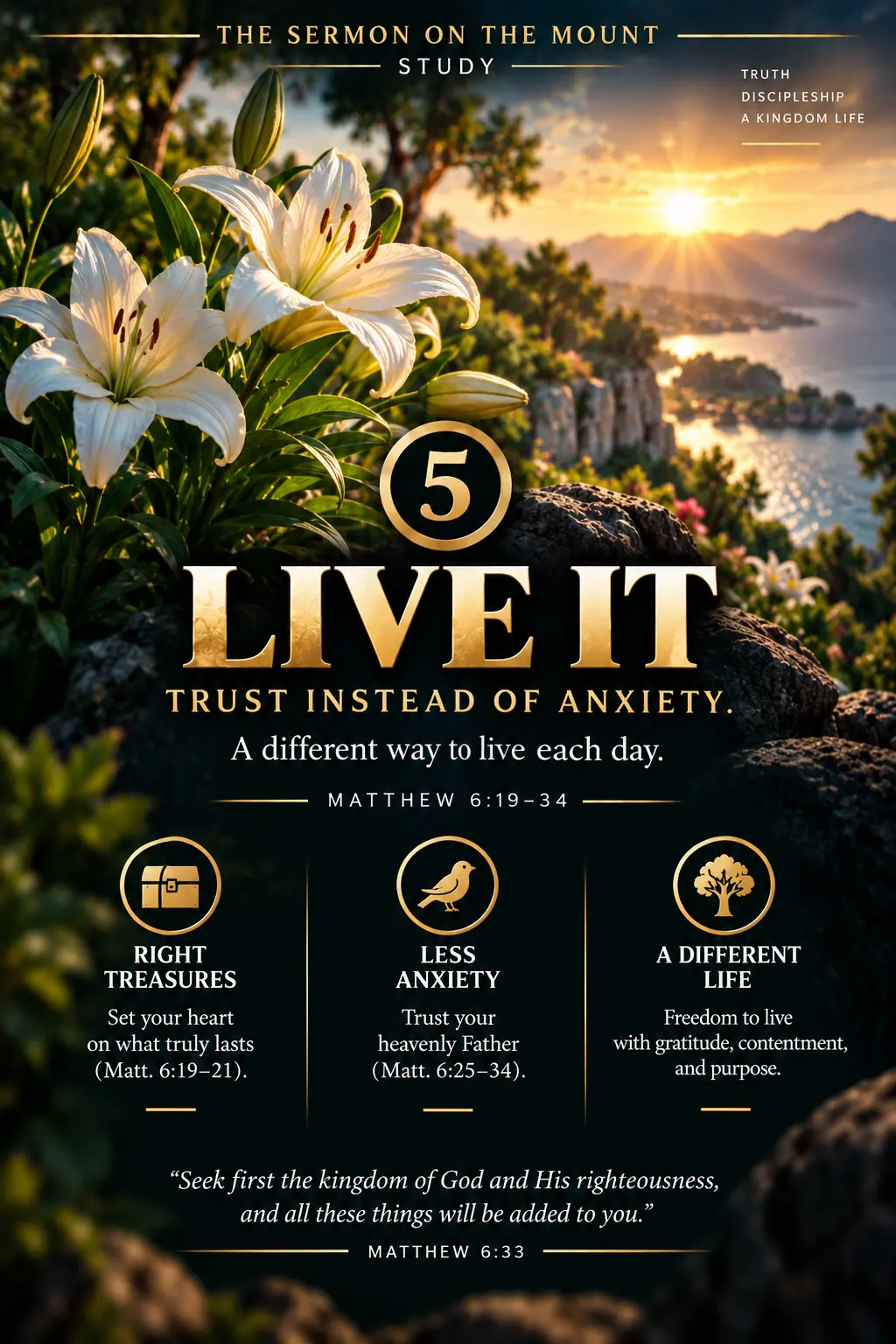
PART THREE — LIVE IT
Trust the Father Enough to Live Differently
Jesus has taught His disciples to pray, “Your kingdom come” (Matthew 6:10, ESV). Now He turns toward the things that reveal whether God’s Kingdom is actually first in their lives.
Before Jesus reaches “do not be anxious,” He moves through a connected sequence: forgiveness and fasting, treasure, the heart, spiritual sight, two masters, God or mammon, and then anxiety. The progression matters.
TREASURE REVEALS THE HEART
“Do not lay up for yourselves treasures on earth…” — Matthew 6:19, ESV
Jesus does not tell His disciples that treasure is irrelevant. He tells them where to store it: “lay up for yourselves treasures in heaven” (Matthew 6:20, ESV). Then He explains why:
“For where your treasure is, there your heart will be also.” — Matthew 6:21, ESV
Treasure reveals what the heart values. The question is not merely how much a person owns. The deeper question is what he is living for. Earthly treasure is temporary. Kingdom treasure lasts. Once again Jesus asks His followers to live now according to a future reality they trust Him to fulfill.
TWO MASTERS — GOD OR MAMMON
Jesus then makes the issue one of allegiance:
“No one can serve two masters…” — Matthew 6:24, ESV
He concludes, “You cannot serve God and money” (Matthew 6:24, ESV). Older English translations often preserve the term mammon, from an Aramaic word associated with wealth or possessions. Jesus does not merely warn that excessive spending is unwise. He personifies wealth as a rival master: something that can demand a person’s service, trust, and allegiance. His point is about mastery. God and mammon cannot both rule the same life.
This connects treasure, heart, and service. What I treasure pulls at my heart, and what rules my heart can become what I serve.
THEREFORE — DO NOT WORRY
Immediately after saying that no one can serve both God and money, Jesus says:
“Therefore I tell you, do not be anxious about your life, what you will eat or what you will drink, nor about your body, what you will put on.” — Matthew 6:25, ESV
That “therefore” matters. Jesus has not suddenly changed subjects. His teaching about anxiety grows directly out of His teaching about treasure and allegiance.
If money, possessions, and our own ability are what we trust to secure the future, anxiety follows naturally. Jesus points His disciples somewhere else: to their Father.
Look at the birds. “Your heavenly Father feeds them” (Matthew 6:26, ESV). Look at the lilies. God clothes the grass of the field (Matthew 6:28–30). Jesus is not teaching laziness or telling His followers never to plan or work. He is confronting the fear that drives us to live as though everything depends entirely upon us.
Then comes the statement that answers the ancient lie of Eden:
“Your heavenly Father knows that you need them all.” — Matthew 6:32, ESV
The serpent’s insinuation was that God could not be fully trusted and that humanity needed to grasp for itself. Jesus tells His disciples that their Father already knows what they need.
Do not build your life around fear of not having enough. Trust your Father.
SEEK FIRST THE KINGDOM
Then Jesus brings the entire movement to its climax:
“But seek first the kingdom of God and his righteousness, and all these things will be added to you.” — Matthew 6:33, ESV
Earlier Jesus taught His disciples to pray, “Your kingdom come.” Now He tells them to “seek first the kingdom of God.” Those statements belong together.
Pray for the Kingdom. Then live as though the Kingdom is actually your first priority.
This is where the Sermon hits ordinary life. What comes first when decisions involve money, work, possessions, comfort, status, security, food, clothing, and tomorrow? Jesus does not say these needs are imaginary. He says the Father knows about them.
The disciple’s responsibility is to put God’s Kingdom and righteousness first and trust the Father with what follows.
WHAT DOES KINGDOM-FIRST LIVING LOOK LIKE?
Jesus does not end the Sermon at Matthew 6:33. Having told His disciples to seek the Kingdom first, He continues with practical instruction about how Kingdom people live among other people and make decisions in a fallen world.
EXAMINE YOURSELF BEFORE CONDEMNING OTHERS — Matthew 7:1–5
“Judge not, that you be not judged” (Matthew 7:1, ESV) is not a command to abandon moral discernment. Jesus immediately gives the picture of someone trying to remove a speck from another person’s eye while a log remains in his own. The disciple begins with honest self-examination and repentance before attempting to correct someone else.
EXERCISE DISCERNMENT — Matthew 7:6
Jesus then warns His followers not to give what is holy to dogs or throw pearls before pigs. Kingdom humility does not mean the abandonment of discernment. His disciples must learn to recognize situations in which what is holy is being treated with contempt.
KEEP ASKING YOUR FATHER — AND TRUST HIM TO GIVE WHAT IS GOOD — Matthew 7:7–11
“Ask, and it will be given to you; seek, and you will find; knock, and it will be opened to you.” — Matthew 7:7, ESV
Jesus returns again to dependence upon the Father. But He does not promise that the Father will simply give His children whatever they decide they want. Jesus describes the Father as the One who gives what is genuinely good.
He illustrates this with ordinary family life. If a son asks for bread, a father does not give him a stone. If he asks for a fish, his father does not give him a serpent (Matthew 7:9–10). Then Jesus concludes:
“If you then, who are evil, know how to give good gifts to your children, how much more will your Father who is in heaven give good things to those who ask him!” — Matthew 7:11, ESV
The promise is not: Ask for anything you want and God must give you exactly what you requested. The promise is better: Your Father knows how to give what is good.
That requires trust because the Father’s judgment about what is good may not always match ours. A child may ask for something he believes is good while a loving father knows otherwise. Kingdom prayer therefore does not place God under our direction. It brings our requests to a Father whose wisdom and goodness we trust.
Luke’s parallel account adds another dimension. Where Matthew says the Father gives “good things,” Luke records Jesus saying that the heavenly Father will “give the Holy Spirit to those who ask him” (Luke 11:13, ESV). Matthew gives the broader promise: the Father gives “good things.” Luke helps us see that those good gifts include the Holy Spirit. Jesus is clearly promising something far greater than material prosperity. The Father gives His children what they genuinely need from Him, including what they need spiritually.
This connects directly with what Jesus has already taught: “your heavenly Father knows that you need them all” (Matthew 6:32, ESV). The Father knows what His children need, invites them to ask, and gives what is good.
There is also a profound connection back to Eden. Humanity’s first rebellion centered upon “the tree of the knowledge of good and evil” (Genesis 2:17, ESV). The serpent challenged whether God’s word and God’s judgment about what was good could be trusted. Adam and Eve chose to grasp and determine for themselves rather than continue depending upon God.
Jesus teaches His disciples the opposite posture: Ask your Father. Trust your Father. Let your Father determine what is truly good.
The disciple does not approach prayer saying, “I know exactly what is good for me, and God must give it to me.” He approaches as a child: “Father, I will ask because I trust You to know what is actually good.”
This continues the central theme of the Sermon. Your Father knows. Your Father is good. Your Father gives what is good. Therefore, trust your Father.
GOING DEEPER — THE FATHER GIVES HIS SPIRIT
Luke’s wording also helps us see something the rest of the New Testament explains more fully. Matthew says the Father gives “good things.” Luke says, “how much more will the heavenly Father give the Holy Spirit to those who ask him!” (Luke 11:13, ESV). In Luke’s statement, the Father is the giver and the Holy Spirit is the extraordinary gift.
That matters for disciples who are being taught how to live according to the coming Kingdom while still living in the present fallen age. Jesus tells them how Kingdom people are to live, but God does not leave His people to produce that life through self-reliance.
THE SPIRIT HELPS US LIVE NOW
Jesus later promises that the Father will give His followers “another Helper” who will be with them forever (John 14:16–17, ESV). The later New Testament shows believers walking by the Spirit (Galatians 5:16), bearing the fruit of the Spirit (Galatians 5:22–23), receiving help from the Spirit in weakness and prayer (Romans 8:26–27), and being strengthened through the Spirit in the inner person (Ephesians 3:16).
THE SPIRIT EQUIPS THE BODY
The Father also equips the Body of Christ through what Paul calls “manifestations of the Spirit”—ways the Spirit works through believers for the good of others. Paul writes:
“To each is given the manifestation of the Spirit for the common good.” — 1 Corinthians 12:7, ESV
Paul then describes manifestations including wisdom, knowledge, faith, gifts of healing, miracles, prophecy, distinguishing between spirits, tongues, and interpretation of tongues (1 Corinthians 12:8–10). He emphasizes that “all these are empowered by one and the same Spirit, who apportions to each one individually as he wills” (1 Corinthians 12:11, ESV).
The stated purpose in 1 Corinthians 12 is “the common good.” Paul develops that through the picture of believers as members of one body who need one another (1 Corinthians 12:12–27), and in chapter 14 he repeatedly emphasizes building up the church. The Spirit equips Christ’s people so that the Body can be strengthened and serve faithfully.
THE SPIRIT AND SPIRITUAL BATTLE
The wider New Testament also shows the Spirit’s importance for daily Christian living and spiritual conflict. Paul tells believers to walk by the Spirit rather than gratify the desires of the flesh (Galatians 5:16). In his teaching on spiritual warfare, he speaks of “the sword of the Spirit, which is the word of God” and of “praying at all times in the Spirit” (Ephesians 6:17–18, ESV).
Matthew 7:11 does not say all of this by itself. But these later passages show us more fully how God equips His people to live the kind of life Jesus is describing. Together they answer an important question raised by the Sermon: How are followers of Jesus supposed to live this extraordinary Kingdom-shaped life while they remain in a fallen world and await the King’s return?
Not through self-sufficiency.
The Father knows what His children need. The Father gives what is good. The Father gives His Spirit. And the Spirit indwells, transforms, strengthens, guides, and equips God’s people according to His will.
The Kingdom is coming. We are not there yet. But God has not left His people alone between the King’s first coming and His future reign.
The King tells us how Kingdom people are to live before the Kingdom arrives in its fullness—and the Father does not leave us to produce that life through our own strength. He gives us His Spirit.
THE GOLDEN RULE — KINGDOM RIGHTEOUSNESS TURNED OUTWARD
“So whatever you wish that others would do to you, do also to them, for this is the Law and the Prophets.” — Matthew 7:12, ESV
That final phrase matters. Earlier Jesus declared that He had not come to abolish “the Law or the Prophets” (Matthew 5:17). Now, as the Sermon approaches its conclusion, He again points back to the Law and the Prophets and gives a remarkably simple expression of how Kingdom righteousness should shape our treatment of other people.
Notice that Jesus makes the command active, not merely passive. He does not simply say, Do not mistreat people. He tells His disciples to actively do for others what they themselves would want others to do for them.
That gathers together much of what Jesus has already taught. Reconcile. Reject lust and exploitation. Speak truthfully. Refuse personal retaliation. Love enemies. Forgive. Examine yourself before condemning someone else. Kingdom righteousness begins in the heart, but it does not remain hidden there. The Inside-Out Kingdom becomes outward action.
THE SERMON NOW MOVES TOWARD A DECISION
After the Golden Rule, Jesus begins bringing the Sermon toward a decision. Jesus has spent most of the Sermon describing the Kingdom, exposing the heart, teaching trust in the Father, and showing His disciples how Kingdom people should live. Now He begins forcing a choice.
The conclusion develops through a series of contrasts: two gates and two ways, good and bad fruit, true and false claims of following Jesus, and finally two builders with two foundations.
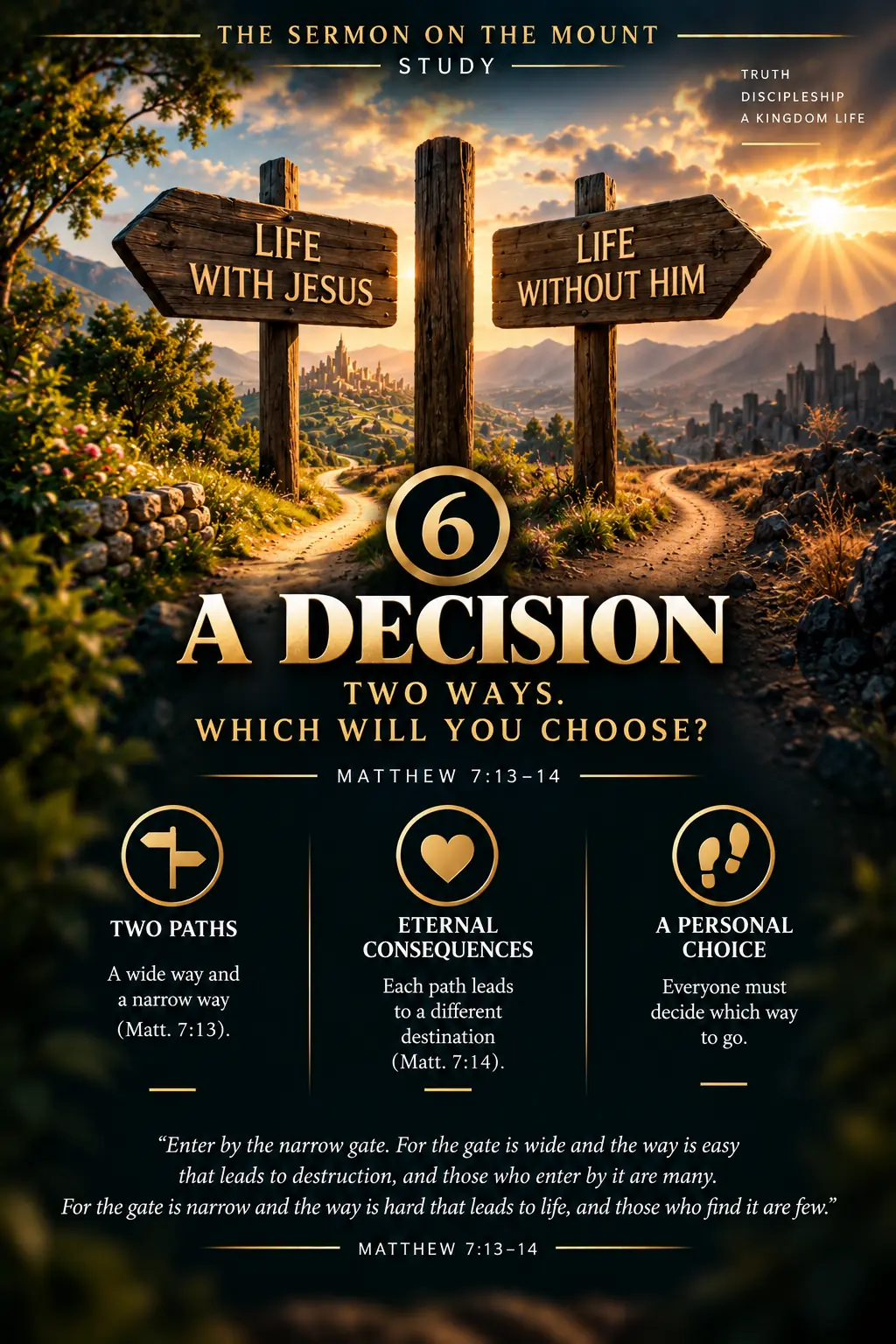
THE NARROW GATE — TWO WAYS, TWO DESTINATIONS
“Enter by the narrow gate. For the gate is wide and the way is easy that leads to destruction…” — Matthew 7:13, ESV
Jesus presents two gates and two ways. One is broad and easy, and many choose it. The other is narrow and hard, and it leads to life (Matthew 7:13–14).
This reaches back to the upside-down character of the Kingdom at the beginning of the Sermon. Jesus has already taught that the world’s definition of who is blessed cannot be trusted. Now He warns that the path that appears easiest, most popular, or most culturally accepted is not necessarily the path that leads to life.
Kingdom disciples therefore cannot use popularity, comfort, or ease as their compass. They must trust the King enough to take the way He says leads to life.
FALSE GUIDES — LOOK AT THE FRUIT
If there are two ways, there will also be voices that can misdirect people. Jesus immediately warns:
“Beware of false prophets, who come to you in sheep’s clothing but inwardly are ravenous wolves.” — Matthew 7:15, ESV
Appearances are not enough. Jesus tells His disciples, “You will recognize them by their fruits” (Matthew 7:16, ESV). Kingdom people must look beyond claims, appearances, and religious presentation to what a person’s teaching and life actually produce.
This continues the Inside-Out theme. What is outwardly visible can disguise what is actually within.
“LORD, LORD” — RELIGIOUS WORDS ARE NOT ENOUGH
Jesus intensifies the warning:
“Not everyone who says to me, ‘Lord, Lord,’ will enter the kingdom of heaven, but the one who does the will of my Father who is in heaven.” — Matthew 7:21, ESV
Religious words are not enough. Even impressive claims of religious activity are not substitutes for genuine relationship with and submission to the King. Jesus strips away another possible false foundation: saying the right things about Him while refusing to live under His authority.
The Sermon has now moved unmistakably from teaching toward decision.
TWO GATES → TWO WAYS → TWO KINDS OF FRUIT → TRUE OR FALSE CLAIMS OF FOLLOWING JESUS → TWO HOUSES
THE TWO HOUSES — WHAT WILL YOU BUILD ON?
Jesus ends the Sermon with two builders:
“Everyone then who hears these words of mine and does them will be like a wise man who built his house on the rock.” — Matthew 7:24, ESV
The critical difference between the two builders is not that one heard Jesus and the other did not. Both hear His words. One hears and does them. The other hears and does not do them (Matthew 7:24, 26).
Jesus is not asking whether His audience enjoyed the Sermon, admired it, agreed with it intellectually, or could explain it. The question is whether they trust His words enough to build their lives upon them.
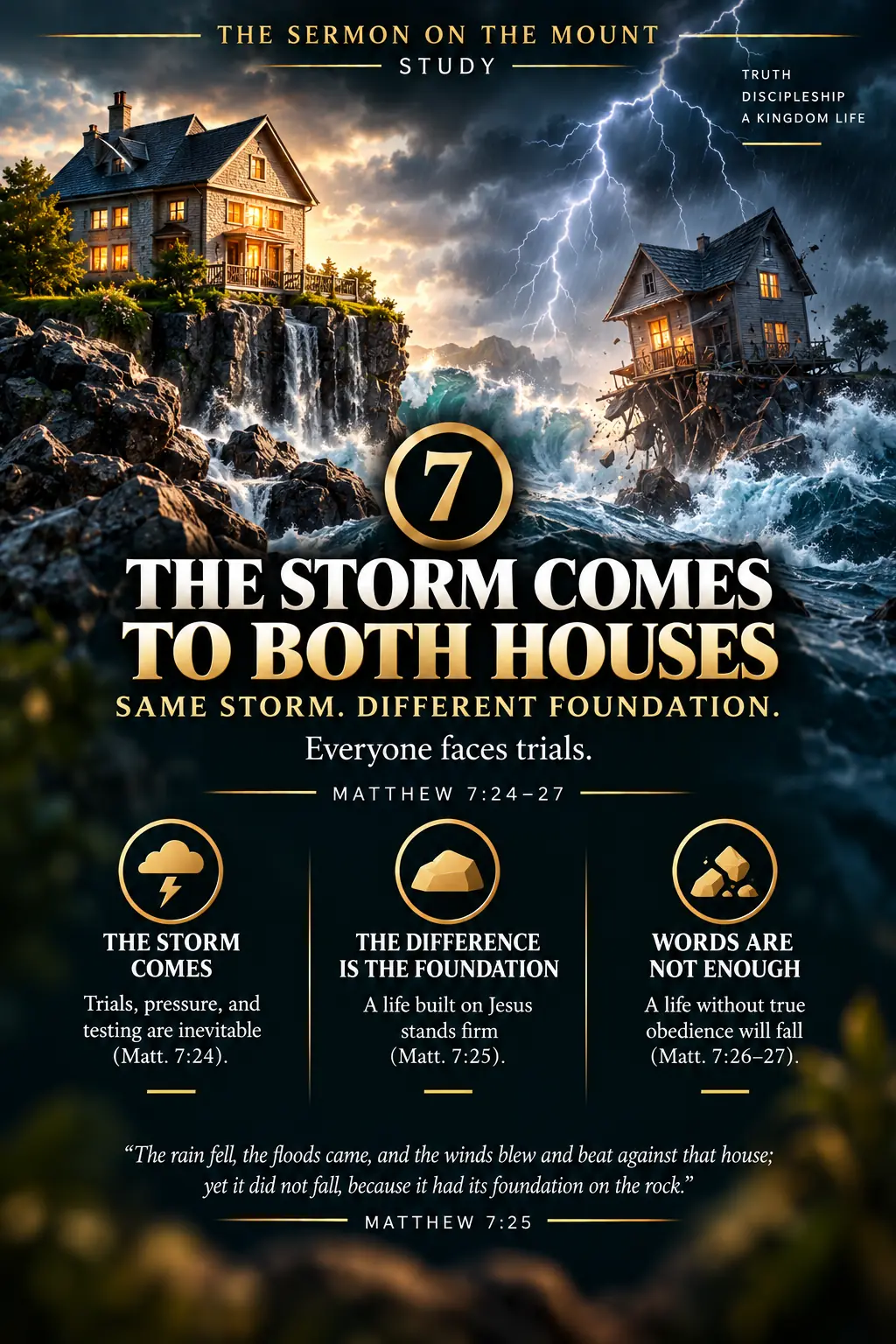
AND THE STORM CAME TO BOTH HOUSES
This detail must not be missed.
Of the house built on rock, Jesus says:
“And the rain fell, and the floods came, and the winds blew and beat on that house…” — Matthew 7:25, ESV
Of the house built on sand, He says:
“And the rain fell, and the floods came, and the winds blew and beat against that house…” — Matthew 7:27, ESV
The storm comes to both builders.
Jesus does not promise the wise builder a storm-free life. Trusting God does not mean sickness never comes, money never becomes tight, relationships never break, persecution never happens, plans never collapse, or painful circumstances never arrive. The difference is not whether the storm comes. The difference is the foundation beneath the house when it does.
On a sunny day, two houses can appear equally secure. The storm reveals what could not easily be seen before.
The storm does not determine the foundation. It reveals it.
That takes us directly back through Jesus’ teaching about trust. It is easy to say, “I trust God,” when circumstances are comfortable. The deeper question appears when what we relied upon begins to shake. Was I ultimately trusting money? Health? My abilities? My plans? Other people? My own understanding? Or the words of the King?
Jesus has already warned His disciples not to build their lives around earthly treasure because it can disappear. He has warned that mammon cannot share mastery with God. He has told them not to live as though they can control tomorrow. He has told them that their Father knows what they need and that they should seek His Kingdom first.
Now He concludes: build on My words.
The storm can naturally picture the trials and pressures of life, but the verses immediately before this show that Jesus’ warning reaches beyond the ordinary storms of life. Jesus has just spoken of the broad way leading to destruction, the narrow way leading to life, false prophets, and people who say “Lord, Lord” yet are rejected. We should therefore not reduce the storm to ordinary life difficulties alone. Jesus is also warning about the day when every life will finally answer to the King.
The foundation that matters is the one that holds through the storms of this life and ultimately before the King.
THE SERMON’S FINAL QUESTION
Now the three parts of the Sermon come together:
PART ONE — REFRAME EVERYTHING: Trust the King’s description of reality.
PART TWO — INTERNALIZE IT: Let God’s Kingdom rule reach the heart.
PART THREE — LIVE IT: Trust your Father, seek His Kingdom first, and actually do what the King says.
Then the storm comes.
Jesus never promises His followers a life without storms. The storm comes to both houses. The difference is what they were standing on when it came.
The greatest sermon ever preached therefore ends with an intensely personal question:
Will you trust Jesus enough to build your life on what He said?
That takes us back to Eden. God spoke. Humanity heard His words. The serpent challenged whether God’s words and God’s goodness could really be trusted. Humanity chose another voice.
Now the King speaks. He describes the Kingdom. He exposes the heart. He teaches His followers to trust the Father. He tells them how to live while awaiting the Kingdom’s fullness. And then He asks, in effect: What will you build on?
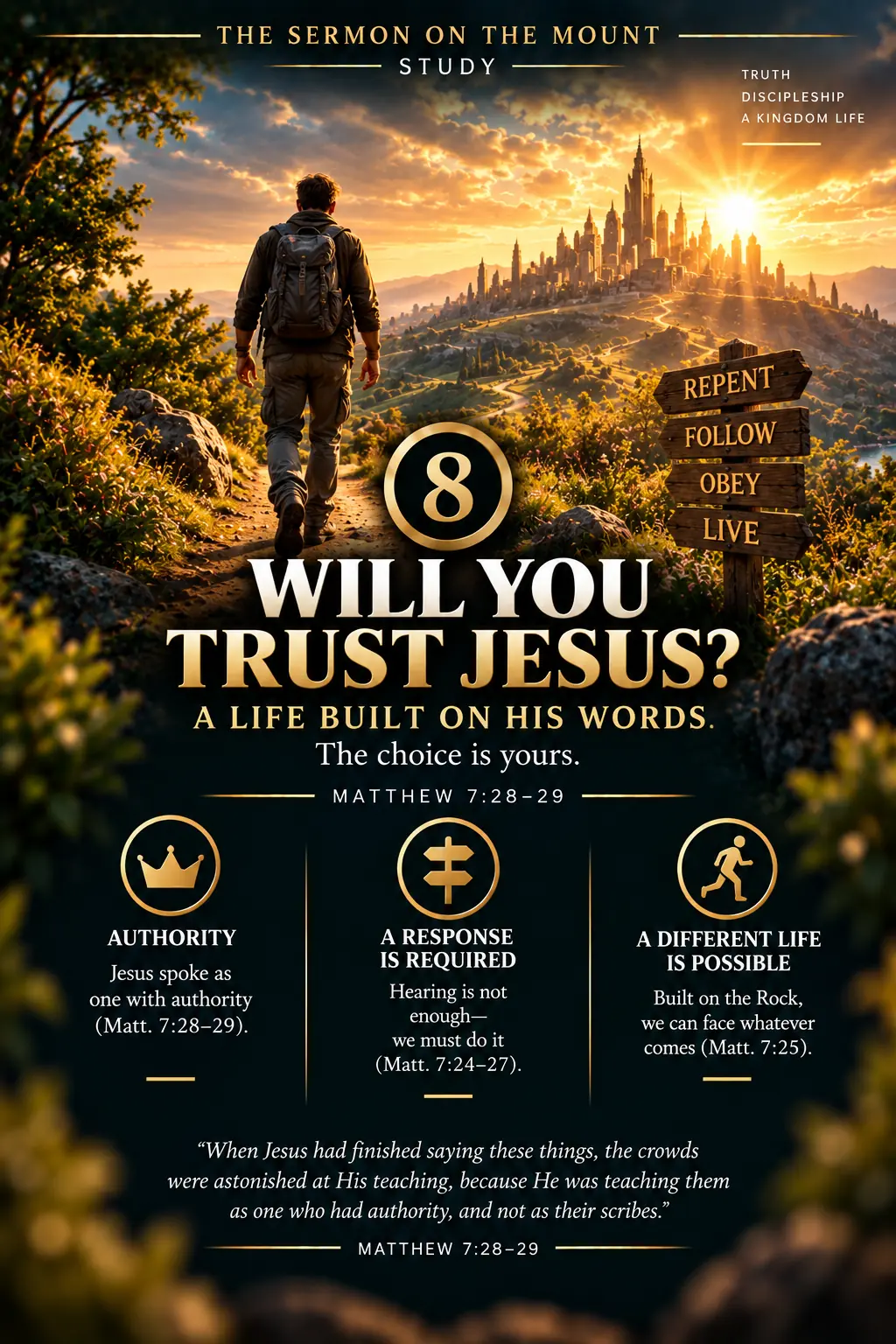
THE CALL TO RESPONSE — WILL YOU TRUST YOUR FATHER?
The Sermon on the Mount cannot remain something we merely understand. Jesus does not end by praising the person who heard and understood Him. The wise person hears His words and does them.
So before looking at someone else’s life, look inward. And pray.
Ask God a difficult question: Where in my life have I not fully trusted You?
Do not answer too quickly. Ask God to search your heart and reveal where you are grasping for control, depending primarily on your own ability, or looking to money, possessions, career, success, comfort, or recognition for security.
Where are you pursuing something ahead of God’s Kingdom? Where are you consumed with tomorrow? Where has anxiety exposed an area in which you are struggling to believe what Jesus has told you: Your Father knows what you need.
REPENT
When God reveals those places, do not merely acknowledge them. If you have refused to trust God, confess it. Tell your Father where you have tried to take control or sought security somewhere other than Him. Tell Him where you have been unwilling to trust His goodness, timing, provision, or direction. Repent means more than recognizing the problem. Turn from it.
ASK FOR FORGIVENESS
Jesus has already taught us to pray, “Forgive us our debts…” (Matthew 6:12, ESV). Bring your failure to your Father and ask Him to forgive you.
ASK FOR GUIDANCE
Then ask: Father, what does trusting You look like here? What needs to change? What do I need to stop pursuing? What am I holding too tightly? What do I need to release? Where do I need to obey? Where do I need to wait? Where do I need to stop trying to control the outcome?
Ask God for wisdom and guidance. Then follow what He has already revealed in His Word.
The question raised in Eden still confronts us: Can God really be trusted?
Jesus’ answer throughout the Sermon on the Mount is yes. Your Father sees. Your Father knows. Your Father provides. Your Father forgives. Your Father hears you when you pray.
So seek first His Kingdom and His righteousness. Pray for His will to be done. Trust Him for your daily bread. Ask for His forgiveness and guidance.
Hear the words of the King, and trust your Father enough to live like He is telling you the truth.
The Sermon on the Mount is not merely teaching to admire. It is truth to build a life upon.
Don’t Stop at Admiring the Sermon
Jesus ends with two builders. Both hear His words. Only one does them. Search your heart, repent where you have resisted the King, ask the Father for forgiveness and guidance, and build your life on what Jesus said.
The Most Important Question
Are you ready for what’s coming?
Knowing the Sermon does not save us. Jesus Christ died for sinners and rose again. Salvation is God’s gift to those who trust in Him.
Escape the Coming Wrath →