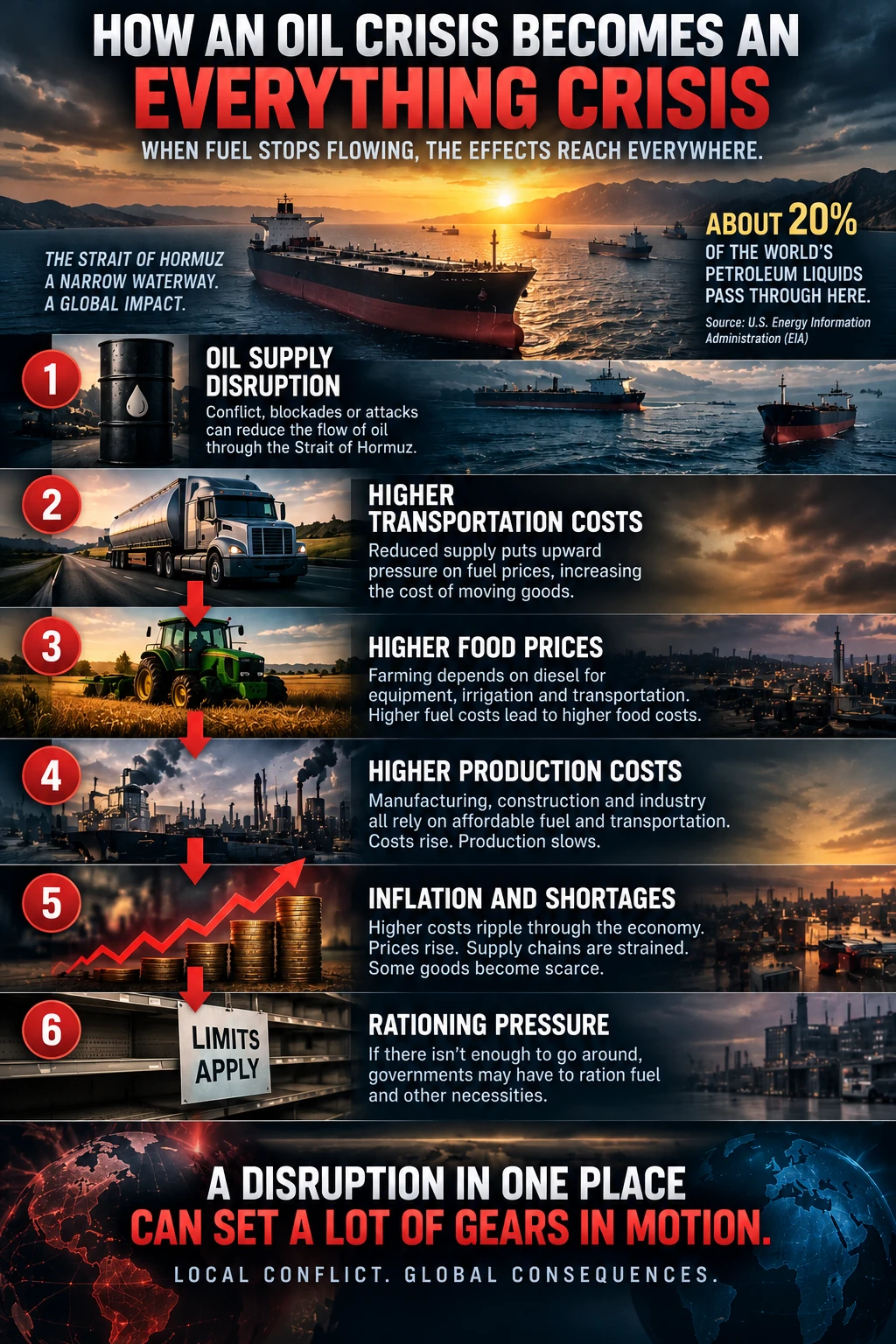
The Strait of Hormuz is a narrow waterway between Iran and Oman. But what happens there can reach almost every corner of the global economy.
Before the current conflict, roughly one-fifth of the world’s petroleum liquids consumption passed through Hormuz. Much of that energy was headed toward the major economies of Asia.
When that flow is seriously disrupted, the problem doesn’t remain in the Middle East.
It moves.
And that is why Daily End Times News is watching the Strait of Hormuz.
UK Maritime Trade Operations said another cargo vessel was struck by an unknown projectile in the Strait of Hormuz, caught fire and was left adrift. The crew abandoned ship, and two casualties were reported. The vessel, attacker and weapon remain unconfirmed. The incident is separate from the two tanker incidents reported earlier and reinforces that safe commercial navigation has not been restored. Separately, the Trump administration has reportedly proposed a U.S.–Arab investment platform for pipelines and other infrastructure that could reduce dependence on Hormuz. The proposal is not a completed agreement: partner and private-sector commitments have not been secured, and technical talks are expected in October.
Iranian Foreign Minister Abbas Araqchi and U.S. envoys Steve Witkoff and Jared Kushner also communicated indirectly through Qatari mediators during the U.N. General Assembly—the first such contacts since July. Iran says it repeated demands including an end to the regional war and U.S. military action. Neither side announced concessions, a framework or an agreement. Reports of an Iranian offer to reopen Hormuz within seven days were denied by semi-official Iranian media and remain disputed. Watch for formal negotiating terms, a ceasefire, a shipping agreement or measurable reopening—not merely continued contact.
Visible Hormuz traffic remained severely restricted on Thursday, with four commodity vessels crossing against a ten-day average of sixteen. Saudi efforts to restore part of the East–West Pipeline and move more crude through Oman eased oil prices, but the main Gulf route and its Saudi bypass remain far below normal capacity. Renewed Saudi–Houthi strikes and the first reported civilian death inside Saudi Arabia add military pressure to the continuing shipping disruption.
Visible commercial traffic through Hormuz fell to only three vessels on Wednesday, compared with 12 Tuesday and a recent daily average of 17. Some ships may be moving with tracking signals turned off, so the figure does not prove that all other traffic stopped. At the same time, China reportedly pressed Iran to restrain the Houthis after a Saudi appeal, while Gulf energy disruption produced blackouts and factory shutdowns in South Asia. The current signal is convergence: restricted shipping, pressure at a second chokepoint, great-power diplomacy and real economic effects are now moving together.
A diplomatic channel is open, but there is still no verified reopening deal. An Iranian official said Monday’s Oman meeting is not expected to produce a signed agreement, while Iran continues seeking an arrangement that would allow it to collect fees from ships using the Strait of Hormuz. Oman opposes that structure. At the same time, Saudi Arabia shut its East-West oil pipeline after a drone attack, weakening another route used to move crude without relying on Hormuz. The signal is therefore both diplomatic and physical: negotiations are active, but the energy system still faces multiple chokepoint pressures.
The chokepoint problem widened again. Iran-aligned Houthi forces reached Perim (Mayun) Island at the mouth of Bab el-Mandeb, while Reuters reported disruption to Saudi Arabia’s East-West pipeline, a principal route for moving crude to the Red Sea without using Hormuz. At the same time, U.S. inflation data showed gasoline prices rising 3.9% in August, illustrating how the energy shock is transmitting into consumer prices and monetary-policy expectations.
Pressure is no longer limited to Hormuz. Iran-aligned Houthi forces have seized Mocha on Yemen’s Red Sea coast and advanced toward the Hanish Islands near Bab el-Mandeb, another major energy and trade chokepoint. Reuters reports roughly 7% of global oil output passes through Bab el-Mandeb. The emerging risk is simultaneous pressure on multiple routes that the energy system uses to move around disruption.
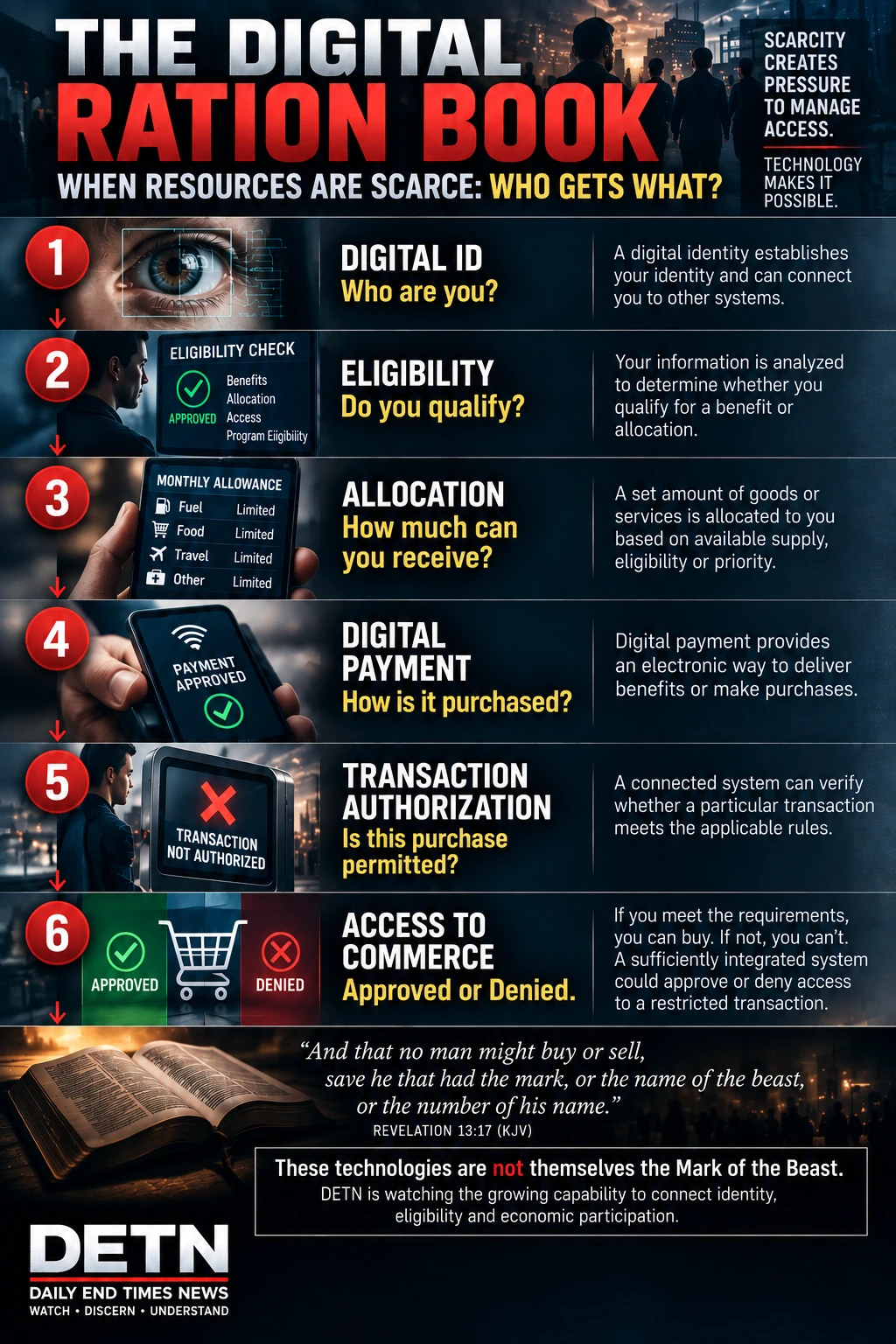
A severe energy shortage can become a scarcity problem. Scarcity creates pressure to decide who gets what. Modern digital systems can connect identity, eligibility, allocation, payment and transaction authorization at a scale paper ration books never could.
The First Gear: Energy
Oil is only the beginning of this story.
The world also needs refined fuels—especially diesel.
Diesel powers much of the machinery underneath modern life: trucks hauling food and merchandise, farm equipment planting and harvesting crops, construction equipment and industrial operations.
So this is much bigger than paying another dollar for gasoline.
When diesel becomes scarce or extremely expensive, the effects move throughout the economy.
The Second Gear: There Are Only So Many Refineries
Crude oil is not diesel.
Someone has to refine it. And there are only so many refineries.
The Russia-Ukraine war gives us a good example. Ukraine has repeatedly attacked Russian refineries. When a refinery goes offline, Russia may actually have more crude oil available to export because less of it can be processed at home—but Russia simultaneously has less ability to produce gasoline, diesel and other finished fuels. Current reporting shows this crude-versus-refined-product split.
Other countries can buy the crude. But somebody still has to refine it.
Existing refineries can work harder, but they have limits. Building major new refineries takes billions of dollars and years.
New refining capacity takes years.
The world has to survive the gap between those two clocks.
We Entered This Crisis With Another Problem
For years, governments encouraged a transition away from oil and toward electric vehicles.
Oil companies heard the message.
Investing billions of dollars in refineries designed to operate for decades became harder to justify if future petroleum demand was expected to decline.
But the transition isn’t finished.
We still depend heavily on diesel for trucks, farms, construction and industry.
That matters when war suddenly removes part of the capacity we still depend upon.
We’re Using the Shock Absorbers
Countries keep strategic petroleum reserves for emergencies.
Those reserves can temporarily replace missing supply and soften the immediate impact of a disruption.
In March, International Energy Agency member countries agreed to make 400 million barrels of emergency oil available—the largest coordinated emergency stock release in IEA history.
But reserves aren’t new production. They’re oil that was produced and stored earlier.
Every barrel used today is one less barrel available for another emergency tomorrow.
It consumes the world’s margin for error.
Then Oil Becomes an Everything Problem
Now follow the gears.
If diesel becomes scarce or expensive, trucking becomes more expensive.
That makes moving food more expensive.
Farming becomes more expensive.
Construction becomes more expensive.
Manufacturing becomes more expensive.
Businesses either absorb those costs, pass them to customers, reduce production—or eventually fail.
The current diesel shortage shows how disruptions in the Middle East and reduced Russian refining can converge in the same market. Diesel prices and supplies are already under significant pressure.
What began as an oil disruption can become inflation, shortages, unemployment and economic contraction.
And if the shortage becomes severe enough, price is no longer the only problem.
There may simply not be enough to go around.
That’s when the question changes.
Who Gets What?
Suppose diesel becomes scarce enough that there isn’t enough for everyone.
Government can’t simply say: “Everybody take what you need.”
Truckers need fuel to deliver food. Farmers need fuel to grow it. Emergency vehicles need fuel. Businesses need fuel. Families need fuel.
Someone eventually has to decide who gets priority.
And once something is rationed, the system has to know:
How much are they allowed?
Have they already received their share?
Is this purchase authorized?
Those questions require one thing first.
The system has to know who you are.
That’s where digital identity becomes important.
The Digital Ration Book
Rationing isn’t new.
During previous wars and shortages, governments used paper ration books, coupons and stamps to distribute scarce gasoline, food and other necessities.
The basic idea was simple: identify the person, determine the allocation, record what they received, and prevent them from exceeding their share.
The principle hasn’t changed. The technology has.
Today, governments around the world are developing what is commonly called digital public infrastructure. The World Bank describes digital identity, digital payments and secure data sharing as core components.
↓
Eligibility — What are you eligible for?
↓
Allocation — How much can you receive?
↓
Digital Payment — How is it purchased?
↓
Transaction Authorization — Is this purchase permitted?
Each piece can have legitimate uses. Digital identity can reduce fraud. Digital payments can deliver emergency assistance quickly. Electronic allocations can make rationing more efficient.
But something important happens when those pieces become connected.
Crisis Can Put the Pieces Together
This is the part we’re watching closely.
Technologies often spread quickly when they solve an urgent problem.
During normal times, someone might ask: Why would I want a system connected to my identity determining what I’m permitted to purchase?
During severe scarcity, the question can sound very different: How else are we going to make sure everyone gets their fair share?
A system doesn’t have to be introduced as a mechanism of control. It can be introduced as a solution.
A way to prevent hoarding. A way to distribute fuel. A way to provide food assistance. A way to send emergency payments. A way to make sure farmers and truckers receive priority.
Each step may make practical sense on its own. But each step can also encourage the adoption and normalization of systems capable of something much larger.
The pieces don’t have to arrive together.
This Is Where Prophecy Gets Our Attention
Revelation describes a future system with an extraordinary economic capability:
— Revelation 13:17
Scripture tells us what the system will do. It doesn’t tell us exactly how it will work.
For most of human history, controlling buying and selling across enormous populations would have been extraordinarily difficult.
Today, many of the pieces that could make unprecedented economic control possible already exist: digital identity, connected databases, digital payments, electronic eligibility and transaction authorization.
That does not mean digital ID is the Mark of the Beast.
A digital payment isn’t the Mark.
Fuel rationing isn’t the Mark.
And trouble in the Strait of Hormuz isn’t the fulfillment of Revelation 13.
We’re watching something more fundamental:
Why We’re Watching Hormuz
↓
Energy scarcity
↓
Diesel and refined-fuel pressure
↓
Higher transportation, farming and manufacturing costs
↓
Higher food prices and pressure on basic necessities
↓
Economic instability and possible shortages
↓
Rationing and government intervention
↓
Who gets what?
↓
Digital identity
↓
Eligibility + allocation
↓
Digital payment + transaction authorization
↓
Access to commerce can be approved—or denied
That final capability should get the attention of anyone who takes Revelation 13 seriously.
We’re not claiming today’s systems are the Mark of the Beast.
We’re watching the development of the capability.
And scarcity could provide a powerful reason to accelerate its adoption.
When there isn’t enough, the government may have to ask: “Are you authorized to have it?”
That is why we’re watching the Strait of Hormuz.
The Strait is thousands of miles away. The gears it turns are not.
The way of escape is still open
The most important question remains:
Have you personally trusted Jesus Christ as Lord and Savior for the forgiveness of sins and eternal life?